Questions 91–150 come in 2 versions: Mathematics & Science or Social Studies. Each candidate answers one of them; all are below.
Q1 · Child Development & Pedagogy
Which of the following describe the exact meaning of given statement ?
“The tendency for the children of highly talented parents to be less talented than their parents and relative tendency for children of very low-class parents to be less low-class.”
(1)Recapitulation
(2)Regression✓ Correct answer
(3)Inheritance
(4)Amplification
Explanation
This is Galton's law of filial regression: the children of extreme parents drift back towards the average of the population. Inheritance (heredity) is the general passing on of traits and does not by itself describe this pull towards the mean.
Q2 · Child Development & Pedagogy
Which of the following trait is important structure of personality, don’t reflect in individuals day per day interactions and its can’t observe directly ?
(1)Surface trait
(2)Common trait
(3)Personal trait
(4)Source trait✓ Correct answer
Explanation
In Cattell's theory, source traits are the deep, underlying structures of personality found by factor analysis (his 16 factors); they are inferred, not seen directly. Surface traits are the opposite: clusters of behaviour visible in everyday interaction.
Q3 · Child Development & Pedagogy
If a student have spatial intelligence, as a teacher what would you suggest specilization area of study to his/him parents for further studies ?
In Gardner's multiple intelligences, spatial (visual-spatial) intelligence is the ability to picture and handle shapes and space, which painters, surveyors and architects use. Mathematicians and physicists mainly use logical-mathematical intelligence; dancers and athletes use bodily-kinaesthetic intelligence.
Q4 · Child Development & Pedagogy
The role of experiential learning in knowledge construction is primarily based on
(1)Experience and reflection only✓ Correct answer
(2)Theory and practice only
(3)Experience and subsequent reflection
(4)Textbook knowledge only
Explanation
BSER's final key accepts both (A) and (C). In Kolb's experiential learning cycle, knowledge is built from concrete experience followed by reflective observation, then abstract ideas and active testing. Textbook knowledge alone is the passive transmission that experiential learning replaces.
Q5 · Child Development & Pedagogy
What is the main cause of extraneous cognitive load ?
BSER's final key accepts both (A) and (B). In Sweller's cognitive load theory, extraneous load is the needless load added by how material is presented and processed (poor design, weak strategies, distractions), and it weighs more on learners who lack background knowledge. The inherent complexity of the task is intrinsic load, a different type.
Q6 · Child Development & Pedagogy
Cources in the area of special education are regulated and controlled by
(1)Rehabilitation Council of India✓ Correct answer
(2)Special Education Council of India
(3)National Council for Teacher Education
(4)National Council of Educational Research and Training
Explanation
The Rehabilitation Council of India (RCI Act 1992) regulates training courses in special education and rehabilitation and keeps the Central Rehabilitation Register. NCTE regulates general teacher education, and there is no 'Special Education Council of India'.
Q7 · Child Development & Pedagogy
Which is not a decision taken by teachers in pre-active phase of teaching ?
(1)Selection of teaching methods
(2)Selection of teaching materials
(3)Evaluation of students✓ Correct answer
(4)Duration of class teaching
Explanation
Jackson's three phases of teaching are pre-active (planning: objectives, methods, materials, time), interactive (classroom teaching) and post-active (evaluation and reflection). Evaluating students therefore belongs to the post-active phase, while deciding the duration of teaching is part of planning.
Q8 · Child Development & Pedagogy
What is the objective of the Pradhan Mantri Innovative Learning Program – Dhruv ?
(1)To provide equal education to all students
(2)To identify and encourage talented children in science and performing art✓ Correct answer
(3)To benefit only government school students
(4)To prepare students for competitive exams
Explanation
Dhruv, launched by the then Ministry of Human Resource Development (now Ministry of Education) on 10 October 2019 at ISRO's Bengaluru headquarters, identifies talented students in science and performing arts and mentors them with experts. It takes students from both government and private schools, so it is not limited to government schools.
Q9 · Child Development & Pedagogy
Match the stages of psycho-social development theory of Erickson to their specific age or period.
I. Ego integrity vs. Despair | i. Early adulthood (20 to 45 years)
II. Autonomy vs. Shame and doubt | ii. Adolescence (12 to 20 years)
III. Intimacy vs. Isolation | iii. Later adulthood (65 years onwards)
IV. Identity vs. Role confusion | iv. 1½ years to 3 years
Choose the correct match.
(1)I – i, II – ii, III – iii, IV – iv
(2)I – ii, II – iii, III – i, IV – iv
(3)I – iii, II – iv, III – i, IV – ii✓ Correct answer
(4)I – iv, II – i, III – iii, IV – ii
Explanation
Erikson's eight stages run from trust vs mistrust (infancy) to ego integrity vs despair (old age). Autonomy vs shame and doubt is the toddler stage (about 1½–3 years), identity vs role confusion is adolescence and intimacy vs isolation is early adulthood.
Q10 · Child Development & Pedagogy
What is the primary aim of curriculum design according to NCF – 2005 ?
(1)Promoting rote memorization
(2)Increasing text book size
(3)Connecting knowledge to life outside school✓ Correct answer
(4)Focusing only on exams
Explanation
The first of NCF 2005's five guiding principles is connecting knowledge to life outside the school; the others include moving away from rote learning and making examinations more flexible. Rote memorisation and exam focus are exactly what NCF 2005 wants to reduce.
Q11 · Child Development & Pedagogy
A child calling Look a likes all men ‘papa’ is an example of which process ?
(1)Conditioning
(2)Development
(3)Learning
(4)Assimilation✓ Correct answer
Explanation
In Piaget's theory, assimilation is fitting a new experience into an existing schema: the child puts every similar-looking man into the 'papa' schema. When the child later learns that only one man is papa and changes the schema, that is accommodation.
Q12 · Child Development & Pedagogy
In Action Research, what does “pre test – post test single group design” refer to ?
(1)A design where multiple groups are compared
(2)A design where one group is tested before and after treatment✓ Correct answer
(3)A design that does not include pretesting
(4)A design to generalize findings
Explanation
In a single-group pre-test–post-test design, the same class is tested, given the intervention (for example remedial teaching) and tested again, and the gain is compared. Action research (Stephen Corey) solves a local classroom problem, so it does not aim to generalise findings.
Q13 · Child Development & Pedagogy
Which factor is negatively effects the learners/child’s linguistics development ?
(1)Nature of family – Nuclear
(2)Freedom of autonomously contacts with peers
(3)Availability of stimulation by parents
(4)Multiple birth (twins)✓ Correct answer
Explanation
Studies of language development (Hurlock and others) find twins and other multiple-birth children often speak later, because they share parental attention and talk mainly with each other (sometimes in a private 'twin language'). Contact with peers and parental stimulation help language grow.
Q14 · Child Development & Pedagogy
Section – 29 of RTE Acts – 2009 primarily deals with :
(1)Curriculum and evaluation procedures✓ Correct answer
(2)Admission processes
(3)Teachers qualifications
(4)Rights of minority institutions
Explanation
Section 29 of the RTE Act 2009 lets the academic authority lay down the curriculum and evaluation procedure, with all-round development, learning through activity and continuous and comprehensive evaluation. Teachers' qualifications are covered in Section 23.
Q15 · Child Development & Pedagogy
Which of the following is not a projective test for personality ?
Cattell's 16 PF is a self-report questionnaire with fixed answers, so it is an objective (non-projective) test. The Rorschach inkblot test, word association test and sentence completion test are projective, because the person reads their own feelings into an open stimulus.
Q16 · Child Development & Pedagogy
“Intelligence is the aggregate or global capacity of an individual to act purposefully, to think rationally and to deal effectively with his environment.” This statement according to
(1)Stern
(2)Jean Piaget
(3)David Wechster✓ Correct answer
(4)Woodworth and Marquis
Explanation
This definition (1939, in The Measurement of Adult Intelligence) is David Wechsler's, who also built the WAIS and WISC intelligence scales. William Stern defined intelligence as the ability to adjust to new situations and gave the idea of the mental quotient.
Q17 · Child Development & Pedagogy
What does “Scaffolding” in the teaching-learning process refer to ?
(1)Permanent support for all learning tasks
(2)Temporary support to help students achieve independence in tasks✓ Correct answer
(3)Evaluating students rote memory
(4)Completing tasks for students
Explanation
Scaffolding (Wood, Bruner and Ross, 1976, built on Vygotsky's zone of proximal development) is temporary help that is withdrawn step by step as the learner becomes able to work alone. Support that is permanent, or doing the task for the child, defeats this purpose.
Q18 · Child Development & Pedagogy
Which stage is known as the “Eureka” movement in creative process ?
(1)Stage of incubation
(2)Stage of revision
(3)Stage of illumination✓ Correct answer
(4)Stage of preparation
Explanation
Graham Wallas (1926) gave four stages of creative thinking: preparation, incubation, illumination and verification. Illumination is the sudden flash of insight ('Eureka'); incubation comes just before it, when the problem is set aside and worked on unconsciously.
Q19 · Child Development & Pedagogy
Which of the following is not the educational implication of growth and developments principles ?
(1)Never give up our efforts to achievement
(2)Everyone should be helped within the sphere of individual strengths and limitations
(3)Plan the environmental/educational experiences according to particular development stage
(4)Make inadequate arrangement for the subsequent progress and consolidation of the progress achieved during specific developmental stages✓ Correct answer
Explanation
Because development is continuous and each stage builds on the last, teachers must make adequate arrangements to consolidate what each stage achieves and to prepare for the next; 'inadequate arrangement' reverses this. Helping each child within their own strengths and limits follows from the principle of individual differences.
Q20 · Child Development & Pedagogy
How much types of disabilities included in the Rights of Persons with Disabilities (RPWD) Act, 2016 ?
(1)12
(2)10
(3)16
(4)21✓ Correct answer
Explanation
The RPwD Act 2016 lists 21 specified disabilities, among them specific learning disabilities, autism spectrum disorder and acid attack victims. The Persons with Disabilities Act 1995 that it replaced covered only 7.
Q21 · Child Development & Pedagogy
Growth and development are two main reasons of __________ and __________ .
(1)Learning and environment
(2)Teaching and environment
(3)Maturity and learning✓ Correct answer
(4)Practice and experience
Explanation
Development results from the interaction of maturation (inner, biologically timed growth) and learning (change through experience and practice). Practice and experience are both parts of learning, so that pair leaves out maturation altogether.
Q22 · Child Development & Pedagogy
Which method of evaluation method is emphasized in NCF – 2005 to reduce stress ?
(1)Summative assessment
(2)Continuous and Comprehensive Evaluation (CCE)✓ Correct answer
(3)Multiple choice tests only
(4)Standardized testing
Explanation
NCF 2005 recommends continuous and comprehensive evaluation, which spreads assessment over the year and covers scholastic and co-scholastic areas, to cut exam stress; the RTE Act 2009 (Section 29) later made CCE part of elementary education. A single summative exam is the high-stakes pattern it wanted to move away from.
Q23 · Child Development & Pedagogy
Which of the following is not the characteristics of creativity ?
(1)Creativity is adventurous and open thinking
(2)Creativity carries ego involvement
(3)Creativity cannot be separated from intelligence
(4)Creativity and school achievement are correlated✓ Correct answer
Explanation
Studies such as Getzels and Jackson (1962) found that highly creative pupils do not necessarily score high in school achievement, which mostly rewards convergent thinking; creativity rests on divergent thinking. Creativity is still linked to intelligence: a minimum level of intelligence is needed for it (threshold theory).
Q24 · Child Development & Pedagogy
How does a concept mapping support to teacher ?
(1)Selection of appropriate instructional material✓ Correct answer
(2)Reducing teaching time
(3)Enhancing students writing skills
(4)Eliminating lesson planning
Explanation
A concept map (Joseph Novak, based on Ausubel's meaningful learning) shows how the ideas of a topic link together, so the teacher can sequence content and choose suitable instructional material. It is a planning aid, so it supports lesson planning rather than removing it.
Q25 · Child Development & Pedagogy
Deleted by BSER — marks given to all
Which of the following effects/influence the human body system (emotions, actions and thoughts) of individual growth and development ?
(1)Nervous system
(2)Physical deformities
(3)Endocrine glands
(4)Defective physical appearance
Explanation
BSER's final key drops this question (bonus, marks to all). As worded it has more than one defensible answer: endocrine glands shape emotions and growth through hormones, but the nervous system also controls emotions, actions and thoughts.
Q26 · Child Development & Pedagogy
What is a key pedagogical dilemma for teachers in constructivist classroom ?
(1)Honoring students attempts to think independently while staying faithful to subject disciplines✓ Correct answer
(2)Not addressing cultural diversity in the classroom
(3)Negotiating authority with parents/guardians
(4)Using technology for collaborative learning
Explanation
Windschitl (2002) names this as a core pedagogical dilemma of constructivist teaching: valuing students' own ideas while still guiding them to the accepted knowledge of the discipline. Ignoring cultural diversity is not a dilemma but a failure, since constructivism builds on learners' backgrounds.
Q27 · Child Development & Pedagogy
Under cognitive learning, the main principle of latent learning is
(1)Learning occurs even out with reinforcement and reward✓ Correct answer
(2)Learning occurs only with rewards
(3)Learning occurs only with punishment
(4)Learning occurs only through imitation
Explanation
Tolman and Honzik's (1930) rats explored a maze without food and formed a cognitive map; when food was later added they ran it at once, showing learning had happened without reward and stayed hidden until needed. Learning only through imitation is Bandura's observational learning.
Q28 · Child Development & Pedagogy
Which is the correct match of adjustment mechanism and its description ?
I. Negativism | a. An individual draws the attention of other persons and develops strong and irrational resistance in accepting suggestion of others
II. Aggression | b. An individual aggressively attributes the frustration to external persons or things
III. Projection | c. Attributing to and observing in others one’s own impulses and traits
IV. Rationalization | d. An individual justifies his beliefs and actions by giving reasons other than those which activated or motivated him
Select from the code given below :
(1)I – a, II – b, III – c, IV – d✓ Correct answer
(2)I – c, II – b, III – a, IV – d
(3)I – b, II – c, III – d, IV – a
(4)I – c, II – d, III – a, IV – b
Explanation
Each defence mechanism matches its own description in order: negativism is stubborn resistance to others' suggestions, aggression vents frustration outward, projection sees one's own impulses in others, and rationalisation gives acceptable but false reasons. Projection is often confused with negativism, but it is about placing one's own traits on others.
Q29 · Child Development & Pedagogy
What is called “to give opportunity to the human basic instinctive or emotional power to be expressed eg. freedom of interaction to each other” ?
(1)Catharsis✓ Correct answer
(2)Sublimation
(3)Redirection
(4)Contradiction
Explanation
Catharsis is letting pent-up instinctive or emotional energy out through free, safe expression (talking, play, mixing freely). Sublimation is different: it turns the instinct towards a socially valued goal, such as channelling aggression into sport.
Q30 · Child Development & Pedagogy
Which of the following correct structural sequence of Gillford’s model of human intelligence ?
Guilford's Structure of Intellect model has three dimensions, taken as operations (mental processes) on contents (kinds of information) giving products (results); in the 1988 version 6 × 5 × 6 = 180 abilities. Placing products before contents reverses the input–output order.
Q31 · Language: Hindi
Read the Hindi passage and answer the question.
निम्नलिखित गद्यांश के आधार पर प्रश्न संख्या 31 से 40 तक के उत्तर लिखिए :
भारतवर्ष पर प्रकृति की विशेष कृपा रही है । यहाँ पर सभी ऋतुएँ समय पर आती हैं और पर्याप्त काल तक रहती हैं । ऋतुएँ अपने अनुकूल फल-फूलों का सृजन करती हैं । धूप और वर्षा के समान अधिकार के कारण यह भूमि शस्यश्यामला हो जाती है । यहाँ का नगाधिराज हिमालय कवियों को सदा से प्रेरणा देता रहा है और मुक्ति पाने के इच्छुक व्यक्तियों के लिए यहाँ की नदियाँ मोक्षदायिनी समझी जाती रही हैं । यहाँ कृत्रिम धूप और रोशनी की आवश्यकता नहीं पड़ती । यद्यपि भारतीय मनीषी जंगल में रहना पसंद करते थे तथापि वे लोक-व्यवहारों से भी परिचित थे । आज भी वृक्षों में पानी देना एक धार्मिक कार्य समझते हैं । सूर्य और चन्द्र दर्शन शुभ माने जाते हैं ।
‘पर्याप्त’ शब्द में उपसर्ग है –
(1)परि✓ Correct answer
(2)पर्य
(3)परा
(4)आप्त
Explanation
पर्याप्त = परि + आप्त: the prefix is 'परि' (all round), and इ + आ becomes 'या' by यण् sandhi, which is why 'पर्य' seems to appear. 'आप्त' is the root word, not the prefix.
Q32 · Language: Hindi
Read the Hindi passage and answer the question.
निम्नलिखित गद्यांश के आधार पर प्रश्न संख्या 31 से 40 तक के उत्तर लिखिए :
भारतवर्ष पर प्रकृति की विशेष कृपा रही है । यहाँ पर सभी ऋतुएँ समय पर आती हैं और पर्याप्त काल तक रहती हैं । ऋतुएँ अपने अनुकूल फल-फूलों का सृजन करती हैं । धूप और वर्षा के समान अधिकार के कारण यह भूमि शस्यश्यामला हो जाती है । यहाँ का नगाधिराज हिमालय कवियों को सदा से प्रेरणा देता रहा है और मुक्ति पाने के इच्छुक व्यक्तियों के लिए यहाँ की नदियाँ मोक्षदायिनी समझी जाती रही हैं । यहाँ कृत्रिम धूप और रोशनी की आवश्यकता नहीं पड़ती । यद्यपि भारतीय मनीषी जंगल में रहना पसंद करते थे तथापि वे लोक-व्यवहारों से भी परिचित थे । आज भी वृक्षों में पानी देना एक धार्मिक कार्य समझते हैं । सूर्य और चन्द्र दर्शन शुभ माने जाते हैं ।
“यद्यपि भारतीय मनीषी जंगल में रहना पसंद करते थे तथापि वे लोक व्यवहारों से भी परिचित थे ।” में रेखांकित पद हैं – (रेखांकित: यद्यपि, तथापि)
(1)क्रिया विशेषण अव्यय
(2)समुच्चय बोधक अव्यय✓ Correct answer
(3)संबंध बोधक अव्यय
(4)विस्मयादि बोधक अव्यय
Explanation
'यद्यपि … तथापि' join two clauses, so they are conjunctions (समुच्चयबोधक अव्यय), of the subordinating type, like 'यदि … तो' and 'क्योंकि'. A संबंधबोधक अव्यय (such as 'के पास', 'की ओर') links a noun to the rest of the sentence instead.
Q33 · Language: Hindi
Read the Hindi passage and answer the question.
निम्नलिखित गद्यांश के आधार पर प्रश्न संख्या 31 से 40 तक के उत्तर लिखिए :
भारतवर्ष पर प्रकृति की विशेष कृपा रही है । यहाँ पर सभी ऋतुएँ समय पर आती हैं और पर्याप्त काल तक रहती हैं । ऋतुएँ अपने अनुकूल फल-फूलों का सृजन करती हैं । धूप और वर्षा के समान अधिकार के कारण यह भूमि शस्यश्यामला हो जाती है । यहाँ का नगाधिराज हिमालय कवियों को सदा से प्रेरणा देता रहा है और मुक्ति पाने के इच्छुक व्यक्तियों के लिए यहाँ की नदियाँ मोक्षदायिनी समझी जाती रही हैं । यहाँ कृत्रिम धूप और रोशनी की आवश्यकता नहीं पड़ती । यद्यपि भारतीय मनीषी जंगल में रहना पसंद करते थे तथापि वे लोक-व्यवहारों से भी परिचित थे । आज भी वृक्षों में पानी देना एक धार्मिक कार्य समझते हैं । सूर्य और चन्द्र दर्शन शुभ माने जाते हैं ।
किस विकल्प में ‘इक’ प्रत्यय का प्रयोग नहीं हुआ है ?
(1)सटीक✓ Correct answer
(2)रसिक
(3)धार्मिक
(4)वर्णिक
Explanation
'सटीक' is स + टीका (with commentary, hence 'exact'), so the 'ईक' ending is part of the word, not the suffix 'इक'. रस + इक = रसिक, धर्म + इक = धार्मिक and वर्ण + इक = वर्णिक; 'इक' often lengthens the first vowel (धर्म → धार्मिक).
Q34 · Language: Hindi
Read the Hindi passage and answer the question.
निम्नलिखित गद्यांश के आधार पर प्रश्न संख्या 31 से 40 तक के उत्तर लिखिए :
भारतवर्ष पर प्रकृति की विशेष कृपा रही है । यहाँ पर सभी ऋतुएँ समय पर आती हैं और पर्याप्त काल तक रहती हैं । ऋतुएँ अपने अनुकूल फल-फूलों का सृजन करती हैं । धूप और वर्षा के समान अधिकार के कारण यह भूमि शस्यश्यामला हो जाती है । यहाँ का नगाधिराज हिमालय कवियों को सदा से प्रेरणा देता रहा है और मुक्ति पाने के इच्छुक व्यक्तियों के लिए यहाँ की नदियाँ मोक्षदायिनी समझी जाती रही हैं । यहाँ कृत्रिम धूप और रोशनी की आवश्यकता नहीं पड़ती । यद्यपि भारतीय मनीषी जंगल में रहना पसंद करते थे तथापि वे लोक-व्यवहारों से भी परिचित थे । आज भी वृक्षों में पानी देना एक धार्मिक कार्य समझते हैं । सूर्य और चन्द्र दर्शन शुभ माने जाते हैं ।
‘यह भूमि शस्यश्यामला हो जाती है ।’ वाक्य में प्रयुक्त ‘यह’ शब्द है – (रेखांकित: यह)
(1)सार्वनामिक विशेषण✓ Correct answer
(2)परिमाण बोधक विशेषण
(3)निजवाचक सर्वनाम
(4)संबंध वाचक सर्वनाम
Explanation
A pronoun placed directly before a noun to point it out is a pronominal adjective (सार्वनामिक विशेषण): 'यह' qualifies 'भूमि' here. Used alone ('यह सुंदर है') the same word would be a demonstrative pronoun; a निजवाचक सर्वनाम is 'आप/स्वयं'.
Q35 · Language: Hindi
Read the Hindi passage and answer the question.
निम्नलिखित गद्यांश के आधार पर प्रश्न संख्या 31 से 40 तक के उत्तर लिखिए :
भारतवर्ष पर प्रकृति की विशेष कृपा रही है । यहाँ पर सभी ऋतुएँ समय पर आती हैं और पर्याप्त काल तक रहती हैं । ऋतुएँ अपने अनुकूल फल-फूलों का सृजन करती हैं । धूप और वर्षा के समान अधिकार के कारण यह भूमि शस्यश्यामला हो जाती है । यहाँ का नगाधिराज हिमालय कवियों को सदा से प्रेरणा देता रहा है और मुक्ति पाने के इच्छुक व्यक्तियों के लिए यहाँ की नदियाँ मोक्षदायिनी समझी जाती रही हैं । यहाँ कृत्रिम धूप और रोशनी की आवश्यकता नहीं पड़ती । यद्यपि भारतीय मनीषी जंगल में रहना पसंद करते थे तथापि वे लोक-व्यवहारों से भी परिचित थे । आज भी वृक्षों में पानी देना एक धार्मिक कार्य समझते हैं । सूर्य और चन्द्र दर्शन शुभ माने जाते हैं ।
स्रोत के आधार पर ‘चन्द्र’ शब्द है –
(1)तत्सम✓ Correct answer
(2)देशज
(3)विदेशी
(4)तद्भव
Explanation
'चन्द्र' is a Sanskrit word used unchanged in Hindi, so it is तत्सम. Its तद्भव form, changed through Prakrit, is 'चाँद'.
Q36 · Language: Hindi
Read the Hindi passage and answer the question.
निम्नलिखित गद्यांश के आधार पर प्रश्न संख्या 31 से 40 तक के उत्तर लिखिए :
भारतवर्ष पर प्रकृति की विशेष कृपा रही है । यहाँ पर सभी ऋतुएँ समय पर आती हैं और पर्याप्त काल तक रहती हैं । ऋतुएँ अपने अनुकूल फल-फूलों का सृजन करती हैं । धूप और वर्षा के समान अधिकार के कारण यह भूमि शस्यश्यामला हो जाती है । यहाँ का नगाधिराज हिमालय कवियों को सदा से प्रेरणा देता रहा है और मुक्ति पाने के इच्छुक व्यक्तियों के लिए यहाँ की नदियाँ मोक्षदायिनी समझी जाती रही हैं । यहाँ कृत्रिम धूप और रोशनी की आवश्यकता नहीं पड़ती । यद्यपि भारतीय मनीषी जंगल में रहना पसंद करते थे तथापि वे लोक-व्यवहारों से भी परिचित थे । आज भी वृक्षों में पानी देना एक धार्मिक कार्य समझते हैं । सूर्य और चन्द्र दर्शन शुभ माने जाते हैं ।
‘फल-फूलों’ में समास है –
(1)तत्पुरुष समास
(2)कर्मधारय समास
(3)द्वन्द्व समास✓ Correct answer
(4)द्विगु समास
Explanation
फल-फूल = फल और फूल: both parts are equally important and are joined by 'और', which marks द्वन्द्व समास (like माता-पिता). In द्विगु the first part is a number (त्रिलोक).
Q37 · Language: Hindi
Read the Hindi passage and answer the question.
निम्नलिखित गद्यांश के आधार पर प्रश्न संख्या 31 से 40 तक के उत्तर लिखिए :
भारतवर्ष पर प्रकृति की विशेष कृपा रही है । यहाँ पर सभी ऋतुएँ समय पर आती हैं और पर्याप्त काल तक रहती हैं । ऋतुएँ अपने अनुकूल फल-फूलों का सृजन करती हैं । धूप और वर्षा के समान अधिकार के कारण यह भूमि शस्यश्यामला हो जाती है । यहाँ का नगाधिराज हिमालय कवियों को सदा से प्रेरणा देता रहा है और मुक्ति पाने के इच्छुक व्यक्तियों के लिए यहाँ की नदियाँ मोक्षदायिनी समझी जाती रही हैं । यहाँ कृत्रिम धूप और रोशनी की आवश्यकता नहीं पड़ती । यद्यपि भारतीय मनीषी जंगल में रहना पसंद करते थे तथापि वे लोक-व्यवहारों से भी परिचित थे । आज भी वृक्षों में पानी देना एक धार्मिक कार्य समझते हैं । सूर्य और चन्द्र दर्शन शुभ माने जाते हैं ।
‘मुक्ति पाने का इच्छुक’ वाक्यांश के लिए उपयुक्त शब्द है –
(1)मुमूर्ष
(2)मुमुक्षु✓ Correct answer
(3)पिपासु
(4)जिज्ञासु
Explanation
मुमुक्षु means one who desires मोक्ष (liberation). मुमूर्षु is one about to die, पिपासु is thirsty and जिज्ञासु wants to know.
Q38 · Language: Hindi
Read the Hindi passage and answer the question.
निम्नलिखित गद्यांश के आधार पर प्रश्न संख्या 31 से 40 तक के उत्तर लिखिए :
भारतवर्ष पर प्रकृति की विशेष कृपा रही है । यहाँ पर सभी ऋतुएँ समय पर आती हैं और पर्याप्त काल तक रहती हैं । ऋतुएँ अपने अनुकूल फल-फूलों का सृजन करती हैं । धूप और वर्षा के समान अधिकार के कारण यह भूमि शस्यश्यामला हो जाती है । यहाँ का नगाधिराज हिमालय कवियों को सदा से प्रेरणा देता रहा है और मुक्ति पाने के इच्छुक व्यक्तियों के लिए यहाँ की नदियाँ मोक्षदायिनी समझी जाती रही हैं । यहाँ कृत्रिम धूप और रोशनी की आवश्यकता नहीं पड़ती । यद्यपि भारतीय मनीषी जंगल में रहना पसंद करते थे तथापि वे लोक-व्यवहारों से भी परिचित थे । आज भी वृक्षों में पानी देना एक धार्मिक कार्य समझते हैं । सूर्य और चन्द्र दर्शन शुभ माने जाते हैं ।
‘कृपा’ शब्द है –
(1)संज्ञा✓ Correct answer
(2)सर्वनाम
(3)विशेषण
(4)अव्यय
Explanation
'कृपा' (kindness) names a quality or feeling, so it is an abstract noun (भाववाचक संज्ञा). Its adjective form is 'कृपालु'.
Q39 · Language: Hindi
Read the Hindi passage and answer the question.
निम्नलिखित गद्यांश के आधार पर प्रश्न संख्या 31 से 40 तक के उत्तर लिखिए :
भारतवर्ष पर प्रकृति की विशेष कृपा रही है । यहाँ पर सभी ऋतुएँ समय पर आती हैं और पर्याप्त काल तक रहती हैं । ऋतुएँ अपने अनुकूल फल-फूलों का सृजन करती हैं । धूप और वर्षा के समान अधिकार के कारण यह भूमि शस्यश्यामला हो जाती है । यहाँ का नगाधिराज हिमालय कवियों को सदा से प्रेरणा देता रहा है और मुक्ति पाने के इच्छुक व्यक्तियों के लिए यहाँ की नदियाँ मोक्षदायिनी समझी जाती रही हैं । यहाँ कृत्रिम धूप और रोशनी की आवश्यकता नहीं पड़ती । यद्यपि भारतीय मनीषी जंगल में रहना पसंद करते थे तथापि वे लोक-व्यवहारों से भी परिचित थे । आज भी वृक्षों में पानी देना एक धार्मिक कार्य समझते हैं । सूर्य और चन्द्र दर्शन शुभ माने जाते हैं ।
किस विकल्प में सभी शब्द ‘जंगल’ के पर्यायवाची हैं –
(1)विटप, द्रुम, पादप
(2)अरण्य, तरु, कानन
(3)कांतार, विपिन, अटवी✓ Correct answer
(4)ग्रह, दाव, वन
Explanation
कांतार, विपिन and अटवी all mean forest (as do अरण्य, कानन, वन). विटप, द्रुम, पादप and तरु mean tree, and 'ग्रह' (planet) is no synonym of forest.
Q40 · Language: Hindi
Read the Hindi passage and answer the question.
निम्नलिखित गद्यांश के आधार पर प्रश्न संख्या 31 से 40 तक के उत्तर लिखिए :
भारतवर्ष पर प्रकृति की विशेष कृपा रही है । यहाँ पर सभी ऋतुएँ समय पर आती हैं और पर्याप्त काल तक रहती हैं । ऋतुएँ अपने अनुकूल फल-फूलों का सृजन करती हैं । धूप और वर्षा के समान अधिकार के कारण यह भूमि शस्यश्यामला हो जाती है । यहाँ का नगाधिराज हिमालय कवियों को सदा से प्रेरणा देता रहा है और मुक्ति पाने के इच्छुक व्यक्तियों के लिए यहाँ की नदियाँ मोक्षदायिनी समझी जाती रही हैं । यहाँ कृत्रिम धूप और रोशनी की आवश्यकता नहीं पड़ती । यद्यपि भारतीय मनीषी जंगल में रहना पसंद करते थे तथापि वे लोक-व्यवहारों से भी परिचित थे । आज भी वृक्षों में पानी देना एक धार्मिक कार्य समझते हैं । सूर्य और चन्द्र दर्शन शुभ माने जाते हैं ।
‘अनुकूल’ शब्द का विलोम शब्द है –
(1)दुकूल
(2)अनुसार
(3)प्रतिकूल✓ Correct answer
(4)अनुरूप
Explanation
अनुकूल (favourable) and प्रतिकूल (unfavourable) are opposites formed with the prefixes अनु- and प्रति-. अनुरूप and अनुसार are close in meaning to अनुकूल, and दुकूल means fine cloth.
Q41 · Language: Hindi
Read the Hindi passage and answer the question.
निम्नलिखित गद्यांश के आधार पर प्रश्न संख्या 41 से 46 तक के उत्तर लिखिए :
उपभोक्तवादी संस्कृति सामंती संस्कृति का रूप नहीं है, बल्कि यह उपभोग के साधनों की प्रचुरता का प्रमाण है । पहले यह साधन बड़े-बड़े पूँजीपतियों को उपलब्ध होते थे क्योंकि लोगों का मानना था कि ‘करम री सगळै बाजै’ । वे श्रम में विश्वास नहीं रखते थे । आज आम आदमी को भी सभी सुविधाएँ मिलने लगी हैं । पहले सामंती लोग ही मोटरकार और हवाई-जहाज की यात्रा का आनन्द ले पाते थे, पर अब मध्यमवर्गीय व्यक्ति भी इन सबका सुख ले रहा है । अत: यह सामंती संस्कृति का विकसित रूप नहीं है, बल्कि जन-जन की समृद्धि का प्रतीक है ।
निम्नलिखित में से कौन-सा शब्द गद्यांश में पुल्लिंग रूप में प्रयुक्त हुआ है –
(1)समृद्धि
(2)सुविधाएँ
(3)यात्रा
(4)पूँजीपतियों✓ Correct answer
Explanation
'पूँजीपतियों' is the oblique plural of the masculine noun पूँजीपति (बड़े-बड़े पूँजीपतियों को). समृद्धि, सुविधा and यात्रा are feminine (सभी सुविधाएँ मिलने लगी हैं).
Q42 · Language: Hindi
Read the Hindi passage and answer the question.
निम्नलिखित गद्यांश के आधार पर प्रश्न संख्या 41 से 46 तक के उत्तर लिखिए :
उपभोक्तवादी संस्कृति सामंती संस्कृति का रूप नहीं है, बल्कि यह उपभोग के साधनों की प्रचुरता का प्रमाण है । पहले यह साधन बड़े-बड़े पूँजीपतियों को उपलब्ध होते थे क्योंकि लोगों का मानना था कि ‘करम री सगळै बाजै’ । वे श्रम में विश्वास नहीं रखते थे । आज आम आदमी को भी सभी सुविधाएँ मिलने लगी हैं । पहले सामंती लोग ही मोटरकार और हवाई-जहाज की यात्रा का आनन्द ले पाते थे, पर अब मध्यमवर्गीय व्यक्ति भी इन सबका सुख ले रहा है । अत: यह सामंती संस्कृति का विकसित रूप नहीं है, बल्कि जन-जन की समृद्धि का प्रतीक है ।
निम्नलिखित में से किस शब्द का प्रयोग सदैव बहुवचन के रूप में होता है ?
(1)आनन्द
(2)यात्रा
(3)लोग✓ Correct answer
(4)प्रतीक
Explanation
'लोग' always takes plural verbs (लोग कहते हैं), like प्राण, दर्शन, हस्ताक्षर and होश. आनन्द is normally used only in the singular.
Q43 · Language: Hindi
Read the Hindi passage and answer the question.
निम्नलिखित गद्यांश के आधार पर प्रश्न संख्या 41 से 46 तक के उत्तर लिखिए :
उपभोक्तवादी संस्कृति सामंती संस्कृति का रूप नहीं है, बल्कि यह उपभोग के साधनों की प्रचुरता का प्रमाण है । पहले यह साधन बड़े-बड़े पूँजीपतियों को उपलब्ध होते थे क्योंकि लोगों का मानना था कि ‘करम री सगळै बाजै’ । वे श्रम में विश्वास नहीं रखते थे । आज आम आदमी को भी सभी सुविधाएँ मिलने लगी हैं । पहले सामंती लोग ही मोटरकार और हवाई-जहाज की यात्रा का आनन्द ले पाते थे, पर अब मध्यमवर्गीय व्यक्ति भी इन सबका सुख ले रहा है । अत: यह सामंती संस्कृति का विकसित रूप नहीं है, बल्कि जन-जन की समृद्धि का प्रतीक है ।
“उपभोक्तावादी संस्कृति सामंती संस्कृति का रूप नहीं है ।” उपर्युक्त वाक्य में कौन-सा काल है ?
(1)सामान्य वर्तमान काल✓ Correct answer
(2)सामान्य भूतकाल
(3)संदिग्ध भूतकाल
(4)भविष्यत् काल
Explanation
The verb 'है' states a general present fact, so the sentence is in the simple present (सामान्य वर्तमान). संदिग्ध भूतकाल expresses doubt about a past action ('वह आया होगा').
Q44 · Language: Hindi
Read the Hindi passage and answer the question.
निम्नलिखित गद्यांश के आधार पर प्रश्न संख्या 41 से 46 तक के उत्तर लिखिए :
उपभोक्तवादी संस्कृति सामंती संस्कृति का रूप नहीं है, बल्कि यह उपभोग के साधनों की प्रचुरता का प्रमाण है । पहले यह साधन बड़े-बड़े पूँजीपतियों को उपलब्ध होते थे क्योंकि लोगों का मानना था कि ‘करम री सगळै बाजै’ । वे श्रम में विश्वास नहीं रखते थे । आज आम आदमी को भी सभी सुविधाएँ मिलने लगी हैं । पहले सामंती लोग ही मोटरकार और हवाई-जहाज की यात्रा का आनन्द ले पाते थे, पर अब मध्यमवर्गीय व्यक्ति भी इन सबका सुख ले रहा है । अत: यह सामंती संस्कृति का विकसित रूप नहीं है, बल्कि जन-जन की समृद्धि का प्रतीक है ।
गद्यांश में प्रयुक्त राजस्थानी शब्द ‘सगळै’ का अर्थ है –
(1)सर्वत्र✓ Correct answer
(2)गंदा
(3)गलने योग्य
(4)भाग्य
Explanation
In Rajasthani 'सगळो/सगळै' means all, everywhere: 'करम री सगळै बाजै' means fate (karma) holds sway everywhere. 'भाग्य' is the meaning of 'करम' in the saying, not of 'सगळै'.
Q45 · Language: Hindi
Read the Hindi passage and answer the question.
निम्नलिखित गद्यांश के आधार पर प्रश्न संख्या 41 से 46 तक के उत्तर लिखिए :
उपभोक्तवादी संस्कृति सामंती संस्कृति का रूप नहीं है, बल्कि यह उपभोग के साधनों की प्रचुरता का प्रमाण है । पहले यह साधन बड़े-बड़े पूँजीपतियों को उपलब्ध होते थे क्योंकि लोगों का मानना था कि ‘करम री सगळै बाजै’ । वे श्रम में विश्वास नहीं रखते थे । आज आम आदमी को भी सभी सुविधाएँ मिलने लगी हैं । पहले सामंती लोग ही मोटरकार और हवाई-जहाज की यात्रा का आनन्द ले पाते थे, पर अब मध्यमवर्गीय व्यक्ति भी इन सबका सुख ले रहा है । अत: यह सामंती संस्कृति का विकसित रूप नहीं है, बल्कि जन-जन की समृद्धि का प्रतीक है ।
‘प्रमाण’ शब्द का उपयुक्त अर्थ है –
(1)प्रमाद
(2)सबूत✓ Correct answer
(3)प्रमत्त
(4)समूल
Explanation
'प्रमाण' means proof or evidence (सबूत), as in 'प्रचुरता का प्रमाण'. प्रमाद (carelessness) and प्रमत्त (intoxicated) only look alike.
Q46 · Language: Hindi
Read the Hindi passage and answer the question.
निम्नलिखित गद्यांश के आधार पर प्रश्न संख्या 41 से 46 तक के उत्तर लिखिए :
उपभोक्तवादी संस्कृति सामंती संस्कृति का रूप नहीं है, बल्कि यह उपभोग के साधनों की प्रचुरता का प्रमाण है । पहले यह साधन बड़े-बड़े पूँजीपतियों को उपलब्ध होते थे क्योंकि लोगों का मानना था कि ‘करम री सगळै बाजै’ । वे श्रम में विश्वास नहीं रखते थे । आज आम आदमी को भी सभी सुविधाएँ मिलने लगी हैं । पहले सामंती लोग ही मोटरकार और हवाई-जहाज की यात्रा का आनन्द ले पाते थे, पर अब मध्यमवर्गीय व्यक्ति भी इन सबका सुख ले रहा है । अत: यह सामंती संस्कृति का विकसित रूप नहीं है, बल्कि जन-जन की समृद्धि का प्रतीक है ।
‘संस्कृति’ शब्द का बहुवचन रूप होगा –
(1)संस्कृतियाँ✓ Correct answer
(2)साँस्कृतिक
(3)अपसंस्कृति
(4)संस्कृतिएँ
Explanation
Feminine nouns ending in इ/ई take '-याँ' in the plural (रीति → रीतियाँ), so संस्कृति → संस्कृतियाँ. 'सांस्कृतिक' is an adjective, not a plural.
Q47 · Language: Hindi
Answer the Hindi question on language teaching.
‘सहसंबंध विधि’ का विकास किस मूल अवधारणा पर हुआ है ?
(1)सम्पूर्ण ज्ञान पूर्ण इकाई है✓ Correct answer
(2)सीखने-सिखाने की क्रिया एक खेल है
(3)मातृभाषा को बच्चे स्वाभाविक रूप में सीखते हैं
(4)अनुकरण विधि का सिद्धान्त
Explanation
The correlation method rests on the idea that knowledge is one whole, so a subject such as grammar is taught linked with the text, other subjects and life. 'Learning is play' is the basis of the play-way method, and natural learning of the mother tongue underlies the direct method.
Q48 · Language: Hindi
Answer the Hindi question on language teaching.
हिन्दी भाषा शिक्षण में वर्ण एवं शब्दों का शुद्ध उच्चारण और शब्दों की शुद्ध वर्तनी की शिक्षा किस आयु-वर्ग के बच्चों को दी जाती है ?
(1)3 से 5 वर्ष
(2)6 से 9 वर्ष✓ Correct answer
(3)1 से 3 वर्ष
(4)9 से 15 वर्ष
Explanation
Correct pronunciation of letters and words and correct spelling are taught in the early primary years, about 6 to 9 (classes 1–3), when children begin reading and writing. At 3 to 5 the focus is on listening and speaking in pre-school.
Q49 · Language: Hindi
Answer the Hindi question on language teaching.
परीक्षाओं के स्वरूप के आधार पर परीक्षाएँ कितने प्रकार की होती हैं ?
(1)एक
(2)दो
(3)तीन✓ Correct answer
(4)चार
Explanation
By form, examinations are of three kinds: oral (मौखिक), written (लिखित) and practical/performance (प्रायोगिक). Written tests are further split into essay-type, short-answer and objective tests by the form of the questions.
Q50 · Language: Hindi
Answer the Hindi question on language teaching.
व्यष्टि शिक्षण और सामूहिक शिक्षण में समन्वय करने और भाषा सीखने में बच्चों की क्रियाशीलता बढ़ाने का सफल प्रयास है –
(1)भाषा प्रयोगशाला✓ Correct answer
(2)कम्प्यूटर द्वारा अनुदेशन
(3)अभिक्रमित अनुदेशन
(4)डाल्टन प्रणाली
Explanation
In a language laboratory the teacher can address the whole class and also work with each learner at their own console, so it combines group and individual teaching and keeps every child active in listening and speaking. Programmed instruction and the Dalton plan are mainly individual methods.
Q51 · Language: Hindi
Answer the Hindi language question.
जिन वाक्यों में एक मुख्य उपवाक्य तथा एक या एक से अधिक आश्रित उपवाक्य होते हैं, उन्हें कहते हैं –
(1)सरल वाक्य
(2)मिश्र वाक्य✓ Correct answer
(3)संयुक्त वाक्य
(4)समानाधिकरण वाक्य
Explanation
A मिश्र वाक्य has one main clause and one or more dependent clauses joined by कि, जो, क्योंकि, यद्यपि etc. A संयुक्त वाक्य joins two or more independent clauses with और, पर, या.
Q52 · Language: Hindi
Answer the Hindi question on language teaching.
“विद्यालय में हुए छात्रों के व्यवहार-परिवर्तन के सम्बन्ध में प्रदत्तों के संकलन तथा उनकी व्याख्या करने की प्रक्रिया को मूल्यांकन कहते हैं ।” यह परिभाषा किसके द्वारा दी गई है ?
(1)क्वालेन तथा हन्ना✓ Correct answer
(2)ली. जे. क्रॉनबैक
(3)स्टेलने तथा रॉस
(4)रवीन्द्र नाथ टैगोर
Explanation
This definition of evaluation as collecting and interpreting evidence of change in pupils' behaviour is given by Quillen and Hanna. Cronbach is known for defining a test as a systematic procedure for comparing behaviour and for the reliability coefficient (Cronbach's alpha).
Q53 · Language: Hindi
Answer the Hindi language question.
“हाथ कंगन को आरसी क्या ?” लोकोक्ति का निहितार्थ है –
(1)हाथ में कंगन पहने जाते हैं
(2)प्रत्यक्ष को प्रमाण की आवश्यकता नहीं होती✓ Correct answer
(3)कंगन को दर्पण में देखना चाहिए
(4)कंगन शृंगार का आवश्यक अंग है
Explanation
'आरसी' means mirror: a bangle on the wrist can be seen directly, so no mirror is needed, that is, what is evident needs no proof. Option (C) takes the words literally and misses the figurative sense.
Q54 · Language: Hindi
Answer the Hindi question on language teaching.
व्याकरण शिक्षण की प्रचलित विधियाँ कौन-सी हैं ?
(1)निगमन प्रणाली
(2)आगमन प्रणाली
(3)दोनों में से कोई नहीं
(4)(A) और (B) दोनों✓ Correct answer
Explanation
Both are in use: the deductive method (rule first, then examples) and the inductive method (examples first, then the rule drawn by pupils). The inductive method is preferred at the school level, often combined with deduction for practice.
Q55 · Language: Hindi
Answer the Hindi language question.
राजस्थानी शब्द ‘सोगरा’ का हिन्दी रूप है –
(1)मक्के की रोटी
(2)बाजरे की रोटी✓ Correct answer
(3)गेहूँ की रोटी
(4)चावल की रोटी
Explanation
In Rajasthani 'सोगरा' is the thick roti of बाजरा (pearl millet), the staple of western Rajasthan. Maize roti is usually called 'मक्की री रोटी'.
Q56 · Language: Hindi
Answer the Hindi question on language teaching.
इंद्रियों के प्रयोग के आधार पर श्रव्य-दृश्य सामग्री को मोटे तौर पर किन भागों में विभक्त किया जा सकता है ?
(1)एक
(2)दो
(3)तीन✓ Correct answer
(4)चार
Explanation
By the sense used, teaching aids fall into three groups: audio (radio, tape), visual (charts, pictures, blackboard) and audio-visual (television, film). Projected and non-projected is a different, two-way classification.
Q57 · Language: Hindi
Answer the Hindi language question.
‘वचनिका अचलदास खीची री’ रचना के रचयिता हैं –
(1)मीरा बाई
(2)चंद बरदाई
(3)शिवदास गाडण✓ Correct answer
(4)पृथ्वी राज राठौड़
Explanation
'अचलदास खीची री वचनिका' (15th century) is by the Charan poet शिवदास गाडण; it describes Achaldas Khinchi of Gagron and his war with Hoshang Shah of Malwa. Prithviraj Rathore wrote 'वेलि क्रिसन रुकमणी री' and Chand Bardai 'पृथ्वीराज रासो'.
Q58 · Language: Hindi
Answer the Hindi question on language teaching.
परीक्षाओं के वर्गीकरण के प्रमुख आधार कौन-से हैं ?
(1)परीक्षाओं का स्वरूप
(2)प्रश्नों का स्वरूप
(3)(A) और (B) दोनों✓ Correct answer
(4)दोनों में से कोई नहीं
Explanation
Examinations are classified both by their form (oral, written, practical) and by the form of their questions (essay, short-answer, objective). Taking only one basis would leave out half of the usual classification.
Q59 · Language: Hindi
Answer the Hindi language question.
‘वास्तविकता का ज्ञान होना’ अर्थ को प्रकट करने वाला उपयुक्त मुहावरा है –
(1)आँखें खुलना✓ Correct answer
(2)आँखें बन्द करना
(3)आँख का तारा
(4)आँख लगना
Explanation
'आँखें खुलना' means to realise the truth. 'आँख का तारा' means very dear and 'आँख लगना' means to doze off.
Q60 · Language: Hindi
Answer the Hindi question on language teaching.
बच्चे की सीखने सम्बन्धी कठिनाइयों का पता लगाने की क्रिया को कहते हैं –
(1)उपचारात्मक शिक्षण
(2)शैक्षणिक निदान✓ Correct answer
(3)क्रियात्मक अनुसंधान
(4)भाषा शिक्षण
Explanation
Educational diagnosis (often with a diagnostic test) finds what a child finds difficult and why. Remedial teaching comes after it, to remove the difficulties found.
Q61 · Language: English
Phonetic symbols of ‘cloth’ is :
(1)/kləʊð/
(2)/kləʊðz/
(3)/cloθ/
(4)/klɒθ/✓ Correct answer
Explanation
'Cloth' has the short vowel /ɒ/ and ends in the voiceless /θ/: /klɒθ/. /kləʊð/ is 'clothe' and /kləʊðz/ is 'clothes', which have the diphthong /əʊ/ and voiced /ð/.
Q62 · Language: English
A piece of writing that is presented primarily through dialogues. It is known as :
(1)An Elegy
(2)A Sonnet
(3)A Drama✓ Correct answer
(4)A Short Story
Explanation
A drama is written mainly as dialogue between characters, meant to be performed on stage. A short story is told mainly through narration, even if it has some dialogue.
Q63 · Language: English
Choose the option which is not a characteristic of Good Tests and Examinations :
(1)Tests and examinations must take into account the aims and objectives of teaching English
(2)They should ask students only what has been taught
(3)They should be very easy✓ Correct answer
(4)The answers to question should not be very long
Explanation
A good test is valid, reliable and discriminating: it has items of suitable, graded difficulty, so that it separates strong and weak learners. A test that is very easy cannot discriminate, while testing what was taught is part of content validity.
Q64 · Language: English
Vowel sound of ‘hear’ will be :
(1)Iə✓ Correct answer
(2)eə
(3)e3:
(4)æ
Explanation
'Hear' /hɪə/ has the centring diphthong /ɪə/, as in 'near' and 'here'. /eə/ is the vowel of 'hair' and 'care'.
Q65 · Language: English
Which one of these is not an advantage of communicative approach ?
(1)Communicative approach is practical in use
(2)It lays stress on the functional value of the language
(3)It develops the writing ability✓ Correct answer
(4)This approach is situational, meaningful, motivating others and is self rewarding
Explanation
The communicative approach (Hymes' communicative competence) focuses on using language for real purposes, mainly through speaking and listening in situations. Its known weakness is that it gives less attention to writing and to accuracy, so developing writing ability is not counted as its advantage.
Q66 · Language: English
‘Played me false’ means :
(1)tell a lie to me
(2)play a game mischievously with me
(3)tell false about me
(4)deceived me✓ Correct answer
Explanation
'To play someone false' is an idiom meaning to deceive or betray them. Telling a lie is only one way of deceiving and does not carry the sense of betrayal.
Q67 · Language: English
Passage for (Q.Nos.67 – 72) :
To have access of safe water and to avoid water crisis in the near future it is necessary that correct policies and schemes are made. Water conservation and proper management can also be considered as one of the effective steps to avoid water crisis. India has a long tradition of water harvesting. Harvesting rainwater is one of the most effective ways to tackle the water crisis. The basic principle is, to collect the rain water where it falls, use it and let it seep into the ground.
Water harvesting _____ an important technique of water conservation.
(1)has
(2)are
(3)have
(4)is✓ Correct answer
Explanation
'Water harvesting' is a singular (uncountable) subject, so it takes the singular verb 'is'. 'Has' would need a past participle or noun object ('has been', 'has a role').
Q68 · Language: English
Passage for (Q.Nos.67 – 72) :
To have access of safe water and to avoid water crisis in the near future it is necessary that correct policies and schemes are made. Water conservation and proper management can also be considered as one of the effective steps to avoid water crisis. India has a long tradition of water harvesting. Harvesting rainwater is one of the most effective ways to tackle the water crisis. The basic principle is, to collect the rain water where it falls, use it and let it seep into the ground.
Fill in the blanks with appropriate linking devices which are given below :
(for Q.Nos. 68 – 69)
Water conservation _____ proper management can be considered as one of the effective steps to avoid water crisis.
(1)as well as✓ Correct answer
(2)or
(3)as
(4)though
Explanation
The passage says 'Water conservation and proper management', and 'as well as' is the linking device that adds one item to another in the same way. 'Or' would offer a choice, which changes the meaning.
Q69 · Language: English
Passage for (Q.Nos.67 – 72) :
To have access of safe water and to avoid water crisis in the near future it is necessary that correct policies and schemes are made. Water conservation and proper management can also be considered as one of the effective steps to avoid water crisis. India has a long tradition of water harvesting. Harvesting rainwater is one of the most effective ways to tackle the water crisis. The basic principle is, to collect the rain water where it falls, use it and let it seep into the ground.
Fill in the blanks with appropriate linking devices which are given below :
(for Q.Nos. 68 – 69)
_____correct policies _____ schemes are made to avoid water crisis.
(1)As – as
(2)Neither – nor
(3)Both – and✓ Correct answer
(4)Either – or
Explanation
The passage needs correct policies and schemes, both of them, so the correlative 'Both … and' fits, and it agrees with the plural verb 'are'. 'Neither … nor' would say none is made, the opposite of the passage.
Q70 · Language: English
Passage for (Q.Nos.67 – 72) :
To have access of safe water and to avoid water crisis in the near future it is necessary that correct policies and schemes are made. Water conservation and proper management can also be considered as one of the effective steps to avoid water crisis. India has a long tradition of water harvesting. Harvesting rainwater is one of the most effective ways to tackle the water crisis. The basic principle is, to collect the rain water where it falls, use it and let it seep into the ground.
Fill in the blanks with appropriate linking device. Linking devices are given below :
______ water conservation _____ proper management can also be considered as one of the effective steps to avoid water crisis.
(1)Although – yet
(2)Not only – but also✓ Correct answer
(3)Neither – nor
(4)As – so
Explanation
'Not only … but also' adds two positive items together, which matches 'water conservation and proper management' in the passage. 'Although … yet' shows contrast and needs two clauses, not two nouns.
Q71 · Language: English
Passage for (Q.Nos.67 – 72) :
To have access of safe water and to avoid water crisis in the near future it is necessary that correct policies and schemes are made. Water conservation and proper management can also be considered as one of the effective steps to avoid water crisis. India has a long tradition of water harvesting. Harvesting rainwater is one of the most effective ways to tackle the water crisis. The basic principle is, to collect the rain water where it falls, use it and let it seep into the ground.
A correct policy as well as schemes _____ required to avoid water crisis.
(1)is✓ Correct answer
(2)are
(3)have
(4)were
Explanation
With 'as well as', the verb agrees with the first subject, here the singular 'A correct policy', so 'is' is right. 'Are' wrongly agrees with 'schemes', which is only an added phrase.
Q72 · Language: English
Passage for (Q.Nos.67 – 72) :
To have access of safe water and to avoid water crisis in the near future it is necessary that correct policies and schemes are made. Water conservation and proper management can also be considered as one of the effective steps to avoid water crisis. India has a long tradition of water harvesting. Harvesting rainwater is one of the most effective ways to tackle the water crisis. The basic principle is, to collect the rain water where it falls, use it and let it seep into the ground.
An appropriate title for the above passage will be :
(1)Food and water
(2)Water in seas
(3)Water for all✓ Correct answer
(4)Water in rivers
Explanation
The passage is about safe water access, avoiding water crisis and conserving and harvesting rainwater, so 'Water for all' sums it up. It never mentions food, seas or rivers.
Q73 · Language: English
Which one of these is not a challenge of teaching English ?
(1)Several methods in language teaching
(2)Use of teaching materials
(3)Poor lesson preparation
(4)Small class size✓ Correct answer
Explanation
A small class lets the teacher give each learner practice and attention, so it helps rather than hinders English teaching. Large, crowded classes are listed among the main challenges, along with poor preparation and lack of exposure to English.
Q74 · Language: English
An implied simile is also known as :
(1)Metaphor✓ Correct answer
(2)Simile
(3)Assonance
(4)Personification
Explanation
A metaphor compares two things directly without 'like' or 'as' ('Life is a journey'), so it is called an implied or condensed simile. A simile states the comparison openly with 'like' or 'as'.
Q75 · Language: English
Which method helps the learner to speak fluently and accurately in the target language ?
(1)Direct method
(2)Bilingual method✓ Correct answer
(3)Translation method
(4)Substitution method
Explanation
BSER's final key gives the bilingual method. In C. J. Dodson's bilingual method the teacher gives the mother-tongue equivalent of a new English sentence only to make its meaning clear and then moves quickly to practice in English; one of its stated aims is to make learners fluent and accurate in the spoken and written word. The direct method also stresses speech, so it is the closest rival, but the key accepts only (B); the translation method builds reading and grammar rather than fluent speech.
Q76 · Language: English
Choose correct modals to fill the blanks (for Q.Nos. 76 – 77) :
Your sister is very serious, you ________ take her to a doctor. (obligation)
(1)may
(2)shall
(3)must✓ Correct answer
(4)should
Explanation
'Must' expresses strong obligation or necessity, as needed when someone is seriously ill. 'Should' gives advice or a weaker duty, and 'may' expresses permission or possibility.
Q77 · Language: English
Choose correct modals to fill the blanks (for Q.Nos. 76 – 77) :
You _______ punished for this. (Threat)
(1)should be
(2)shall be✓ Correct answer
(3)must be
(4)could be
Explanation
'Shall' with the second or third person expresses the speaker's threat, promise or command ('You shall be punished'). 'Should be' only says punishment would be proper.
Q78 · Language: English
‘The rain in Spain falls mainly on the plain’ which figure of speech is used in this line ?
(1)Assonance✓ Correct answer
(2)Simile
(3)Metaphor
(4)Alliteration
Explanation
The same vowel sound /eɪ/ repeats in rain, Spain, mainly and plain, which is assonance. Alliteration is the repetition of the initial consonant sound ('Peter Piper picked').
Q79 · Language: English
Which one of these is not a principle of Grammar translation method of teaching English ?
(1)Translation interprets foreign phraseology best
(2)Inductive teaching of grammar✓ Correct answer
(3)The words and expressions in English can be easily interpreted in the mother tongue of the students
(4)Structure of a foreign language can be easily learnt, when compared and constructed to those of the mother tongue
Explanation
The grammar translation method teaches grammar deductively: rules are given first and then applied in translation exercises. Inductive grammar teaching (examples first, rule later) belongs to the direct and other modern methods.
Q80 · Language: English
Octave and Sestet are parts of a/an :
(1)Shakespearean sonnet
(2)Petrarchan sonnet✓ Correct answer
(3)English sonnet
(4)Elegy
Explanation
The Petrarchan (Italian) sonnet has an octave of 8 lines (abbaabba) and a sestet of 6 lines. The Shakespearean or English sonnet is built of three quatrains and a closing couplet.
Q81 · Language: English
“Evaluation is an assignment of symbols to a phenomenon in order to characterise the worth or value of a phenomena usually with reference to some social, cultural or scientific standard.” This is quoted by :
(1)T. W. Wringstone
(2)Clara M. Brown
(3)Hanna
(4)Bradfield and Moredock✓ Correct answer
Explanation
This definition of evaluation is by Bradfield and Moredock (1957), and BSER's final key also gives (D). The other names are distractors: Hanna, for example, is known (with Quillen) for defining evaluation as gathering and interpreting evidence of change in pupils' behaviour.
Q82 · Language: English
Short monophthongs are ____ in numbers.
(1)5
(2)6
(3)7✓ Correct answer
(4)8
Explanation
British English (RP) has 12 pure vowels (monophthongs): 7 short (/ɪ/, /e/, /æ/, /ʌ/, /ɒ/, /ʊ/, /ə/) and 5 long. It also has 8 diphthongs, which is why 8 is a tempting wrong answer.
Q83 · Language: English
‘Death lays her icy hands on all’ which figure of speech is used in this line ?
(1)Metaphor
(2)Assonance
(3)Simile
(4)Personification✓ Correct answer
Explanation
Death, an abstract idea, is given a human body and action ('her icy hands'), which is personification. The line echoes James Shirley's 'Death lays his icy hand on kings'; it has no 'like' or 'as', so it is not a simile.
Q84 · Language: English
‘Blowing his own trumpet’ means :
(1)Praising himself✓ Correct answer
(2)Playing his trumpet
(3)Assaulted
(4)Something improbable
Explanation
'To blow one's own trumpet' is an idiom for boasting about oneself. 'Playing his trumpet' is the literal meaning, which idioms do not carry.
Q85 · Language: English
Which one of these is not a quantitative technique of evaluation ?
(1)Observation Techniques✓ Correct answer
(2)Practical Techniques
(3)Oral Techniques
(4)Written Techniques
Explanation
Oral, written and practical tests give scores, so they are quantitative techniques. Observation (with checklists, rating scales, anecdotal records) is a qualitative technique, like interviews and cumulative records.
Q86 · Language: English
Read the following extract of the poem and answer the Q.Nos. 86 – 88 :
How beautiful is the rain ! (1)
How it clatters along the roofs, (2)
Like the tramp of hoofs (3)
How it gushes and struggles out (4)
From the throat of the overflowing spout ! (5)
Across the window-pane (6)
It pours and pours; (7)
and swift and wide, (8)
with a muddy tide (9)
Like a river down the gutter roars. (10)
______ is the rhyme scheme in the last four lines.
(1)A B C D
(2)A B A B
(3)A B B A✓ Correct answer
(4)A A B B
Explanation
The last four lines end in pours, wide, tide, roars: pours/roars rhyme (A) and wide/tide rhyme (B), giving A B B A. A A B B would need the first two lines to rhyme.
Q87 · Language: English
Read the following extract of the poem and answer the Q.Nos. 86 – 88 :
How beautiful is the rain ! (1)
How it clatters along the roofs, (2)
Like the tramp of hoofs (3)
How it gushes and struggles out (4)
From the throat of the overflowing spout ! (5)
Across the window-pane (6)
It pours and pours; (7)
and swift and wide, (8)
with a muddy tide (9)
Like a river down the gutter roars. (10)
The seventh line is an example of :
(1)Metaphor
(2)Simile
(3)Personification
(4)Alliteration✓ Correct answer
Explanation
In 'It pours and pours' the /p/ sound is repeated at the start of words, which BSER's final key treats as alliteration (the line is also a repetition of the same word). There is no comparison, so it is neither a simile nor a metaphor.
Q88 · Language: English
Read the following extract of the poem and answer the Q.Nos. 86 – 88 :
How beautiful is the rain ! (1)
How it clatters along the roofs, (2)
Like the tramp of hoofs (3)
How it gushes and struggles out (4)
From the throat of the overflowing spout ! (5)
Across the window-pane (6)
It pours and pours; (7)
and swift and wide, (8)
with a muddy tide (9)
Like a river down the gutter roars. (10)
Which literary device is used in second and third lines of the extract ?
(1)Metaphor
(2)Simile✓ Correct answer
(3)Alliteration
(4)Assonance
Explanation
The clatter of rain on the roofs is compared to 'the tramp of hoofs' using 'Like', so it is a simile (line 10, 'Like a river', is another). A metaphor would make the comparison without 'like' or 'as'.
Q89 · Language: English
Phonetic symbols for ‘clumsy’ is :
(1)/klʌmzi/✓ Correct answer
(2)/kl3:msi/
(3)/kəmsI:/
(4)/kl3mzi/
Explanation
'Clumsy' is pronounced /ˈklʌmzi/, with the short vowel /ʌ/ (as in 'cup') and a voiced /z/. /ɜː/ is the long vowel of 'bird', which 'clumsy' does not have.
Q90 · Language: English
Which one is not an advantage of Online Remedial Teaching ?
(1)The instruction pace is flexible as well as the class participation
(2)It is not cost effective✓ Correct answer
(3)Elimination of barriers of time and space
(4)A well designed online course makes it easy for the students to navigate and search adequate informations
Explanation
Online remedial teaching is usually counted as cost-effective (no travel, reusable material), so 'it is not cost effective' is not an advantage at all. Flexible pace and freedom from time and place are its main strengths.
Questions 91–150: Mathematics & Science
Q91 · Mathematics
In how much time will the value of some money increase by 40% at the rate of 5% annual simple interest ?
(1)5 year
(2)6 year
(3)10 year
(4)8 year✓ Correct answer
Explanation
Simple interest of 40% of the principal at 5% a year needs 40 ÷ 5 = 8 years (SI = P × R × T/100). 10 years would give 50%, not 40%.
Q92 · Mathematics
In a histogram, the heights of the rectangles belong to those classes :
(1)Inversely proportional to frequencies
(2)Proportional to frequencies✓ Correct answer
(3)Proportional to class-interval
(4)Inversely proportional to the class-interval
Explanation
In a histogram with equal class widths, each rectangle's height is proportional to the frequency of its class, and the class interval sets the width. (With unequal widths the area, not the height, is made proportional to frequency.)
Q93 · Mathematics
If the side of a square is increased by 25%, its area will increase by :
(1)56.25%✓ Correct answer
(2)66.25%
(3)25%
(4)125.25%
Explanation
The new side is 1.25a, so the area is (1.25)² a² = 1.5625 a², an increase of 56.25% (or 25 + 25 + 25×25/100). 25% is the change in the side only.
Q94 · Mathematics
Which of the following statements does not reflect the nature of mathematics ?
(1)Knowledge in mathematics is clear and logical
(2)The rules, principles and formulas of mathematics are universal
(3)The field of generalization in mathematics is limited✓ Correct answer
(4)The language of mathematics is well defined
Explanation
Mathematics is built on wide generalisation: a result proved once (such as the angle sum of a triangle) holds for every case, so its field of generalisation is broad, not limited. Clarity, logic, universal rules and precise language are all accepted features of its nature.
Q95 · Mathematics
“Mathematics is the study of abstract system built of abstract elements. These elements are not described in concrete fashion.” This statement is said by :
(1)Marshal H. Stone✓ Correct answer
(2)Hogven
(3)I. K. Davis
(4)B. S. Bloom
Explanation
This definition of mathematics as the study of abstract systems is Marshall H. Stone's (in the Hindi text the second sentence is printed as 'मूर्त रूप में परिभाषित'; the English 'not described in concrete fashion' is the original sense). Lancelot Hogben called mathematics 'the mirror of civilisation'.
Q96 · Mathematics
A parallelogram and a triangle are equal in area and lie on the same base. If the height of the parallelogram is 2 cm, then the height of the triangle is :
(1)1 cm
(2)2 cm
(3)3 cm
(4)4 cm✓ Correct answer
Explanation
b × 2 = ½ × b × h gives h = 4 cm: a triangle needs twice the height of a parallelogram on the same base to have the same area. 1 cm comes from halving instead of doubling.
Q97 · Mathematics
The value of (2⁰ + 2⁻¹ + 2⁻²) is :
(1)7/4✓ Correct answer
(2)4/7
(3)1/4
(4)3/4
Explanation
2⁰ = 1, 2⁻¹ = 1/2 and 2⁻² = 1/4, so the sum is 1 + 1/2 + 1/4 = 7/4. 3/4 comes from wrongly taking 2⁰ as 0.
Q98 · Mathematics
The situations presented by the teacher in the classroom to attract the attention of students towards a new topic are called :
(1)Prior knowledge
(2)Home work
(3)Statement of aim
(4)Introduction✓ Correct answer
Explanation
In a Herbartian lesson plan, the introduction (preparation) step uses questions or situations, built on prior knowledge, to draw pupils towards the new topic. The statement of aim comes just after it and tells pupils what will be studied.
Q99 · Mathematics
The area of an equilateral triangle of side 3 cm will be :
(1)9√3/4 cm²✓ Correct answer
(2)6√2/4 cm²
(3)3√3/4 cm²
(4)6√2/5 cm²
Explanation
Area = (√3/4) × a² = (√3/4) × 9 = 9√3/4 cm². 3√3/4 uses a instead of a².
Q100 · Mathematics
“Evaluation is judgement or interpretation that one draws from one information at hand about a pupil’s work.” This statement is said by :
(1)Clark and Starr✓ Correct answer
(2)James M. Lee
(3)Quillen and Hanna
(4)Stevenson
Explanation
As per BSER's final key, this definition is by Clark and Starr. Quillen and Hanna defined evaluation instead as collecting and interpreting evidence of change in pupils' behaviour (the definition asked in Q52 of this paper).
Q101 · Mathematics
The difference between the maximum value and minimum value at data in a given group is called :
(1)Range✓ Correct answer
(2)Mean
(3)Frequency
(4)Median
Explanation
Range = highest value − lowest value; it is the simplest measure of spread. Mean and median are measures of central tendency, not of spread.
Q102 · Mathematics
How many decimal parts of an hour is one second ?
(1)0.002561
(2)0.000277✓ Correct answer
(3)0.000123
(4)0.002077
Explanation
One hour has 3600 seconds, so 1 second = 1/3600 hour = 0.000277… hour. 0.002077 and 0.002561 are about 7–9 times too large.
Q103 · Mathematics
P(E) + P(Ē) equals :
(1)0
(2)2
(3)1✓ Correct answer
(4)3
Explanation
An event E and its complement Ē (E not happening) together cover every outcome, so P(E) + P(Ē) = 1. Each probability lies between 0 and 1, so the sum can never be 2.
Q104 · Mathematics
The action verb, ‘Predict’ is related to which objective ?
(1)Analysis
(2)Application✓ Correct answer
(3)Knowledge
(4)Creative
Explanation
As per BSER's final key, 'predict' belongs to application: in the RCEM (Regional College of Education, Mysore) list of action verbs based on Bloom's taxonomy, 'predicts' is a specification of the application objective, along with 'applies' and 'infers' in a new situation. Analysis uses verbs such as 'separates', 'compares' and 'classifies'.
Q105 · Mathematics
The student who performs simple mathematical operations without the help of paper and pencil is called :
(1)Written Maths
(2)Oral Maths✓ Correct answer
(3)Geometry
(4)Example
Explanation
Doing simple calculations mentally, without paper and pencil, is oral (mental) mathematics, which builds speed and number sense. Written mathematics is the same work done step by step on paper.
Q106 · Mathematics
If a test measures the purpose for which it has been designed, then it implies :
(1)Reliability
(2)Validity✓ Correct answer
(3)Objectivity
(4)Discrimination
Explanation
Validity is the extent to which a test measures what it was designed to measure. Reliability is different: it is the consistency of scores when the test is repeated.
Q107 · Mathematics
A factor of (x³ – 8) is :
(1)(x + 2)
(2)(x² + 2x + 4)✓ Correct answer
(3)(x – 4)
(4)(x² – 2x + 4)
Explanation
By a³ − b³ = (a − b)(a² + ab + b²), x³ − 8 = (x − 2)(x² + 2x + 4). (x² − 2x + 4) is a factor of x³ + 8, not x³ − 8.
Q108 · Mathematics
After diagnostic testing, it is necessary for mentally retarded students to :
(1)General teaching
(2)Question wise teaching
(3)Instructional teaching
(4)Remedial teaching✓ Correct answer
Explanation
A diagnostic test locates the specific difficulties, and remedial teaching then works on exactly those weak points. Going back to general teaching would repeat the instruction that did not work for these pupils.
Q109 · Mathematics
The point on x-axis is :
(1)(2, 3)
(2)(2, 0)✓ Correct answer
(3)(0, 2)
(4)(2, 2)
Explanation
Every point on the x-axis has y-coordinate 0, so (2, 0) lies on it. (0, 2) has x = 0 and lies on the y-axis.
Q110 · Mathematics
By giving 10% discount on an item there is a profit of 20%. If this discount is 20%, then what will be the profit ?
(1)6 2/3 %✓ Correct answer
(2)3 1/2 %
(3)7 1/4 %
(4)12 1/2 %
Explanation
Let CP = 100: 0.9 × MP = 120, so MP = 400/3. At 20% discount SP = 0.8 × 400/3 = 320/3 = 106.67, a profit of 6 2/3%. Simply taking 20 − 10 = 10% off the profit is the usual mistake.
Q111 · Mathematics
If the surface area of a cube is 600 cm², then the length of its diagonal will be :
(1)3√10 cm
(2)10√3 cm✓ Correct answer
(3)10√2 cm
(4)10 cm
Explanation
6a² = 600 gives a = 10 cm, and the cube's diagonal is a√3 = 10√3 cm. 10√2 cm is only the diagonal of one face.
Q112 · Mathematics
The appropriate method for establishing formulas up to the middle stage in teaching mathematics is :
(1)Demonstration method
(2)Deductive method
(3)Inductive method✓ Correct answer
(4)Lecture method
Explanation
In the inductive method pupils work through several examples and discover the formula themselves (from specific to general), which suits the upper primary stage. The deductive method gives the formula first and is better for practice at higher classes.
Q113 · Mathematics
The sum of the largest and smallest fractions among the fractions 5/9, 3/7, 11/13, 6/11 and 7/8 is :
(1)1 5/8
(2)1 17/53
(3)1 17/56✓ Correct answer
(4)1 13/99
Explanation
In decimals the fractions are 0.556, 0.429, 0.846, 0.545 and 0.875, so the largest is 7/8 and the smallest 3/7. 7/8 + 3/7 = 49/56 + 24/56 = 73/56 = 1 17/56. 11/13 looks largest but is less than 7/8.
Q114 · Mathematics
If the ratio of supplementary and complementary angle of an angle is 5 : 2, then the value of the angle will be :
(1)20°
(2)60°
(3)30°✓ Correct answer
(4)150°
Explanation
(180° − x) : (90° − x) = 5 : 2 gives 360 − 2x = 450 − 5x, so x = 30°. Check: 150° : 60° = 5 : 2. 150° is the supplement, not the angle.
Q115 · Mathematics
The largest five-digit perfect square number is :
(1)10000
(2)99586
(3)99999
(4)99856✓ Correct answer
Explanation
√99999 ≈ 316.2, so the largest five-digit square is 316² = 99856 (317² = 100489 has six digits). 10000 = 100² is the smallest five-digit square.
Q116 · Mathematics
If the ratio of heights of two cylinders of equal volume is 1 : 3 then the ratio of their radii will be :
(1)1 : 3
(2)√3 : 1✓ Correct answer
(3)1 : √2
(4)√5 : 2
Explanation
πr₁²h₁ = πr₂²h₂ gives r₁²/r₂² = h₂/h₁ = 3, so r₁ : r₂ = √3 : 1. Radius varies as the square root of 1/height, not directly with height, so 1 : 3 is wrong.
Q117 · Mathematics
The ratio of female and male employees in a factory is 3 : 5. If the number of females is 40 less than the number of male, then how many total employees are there in the factory ?
(1)60
(2)160✓ Correct answer
(3)100
(4)200
Explanation
5k − 3k = 2k = 40 gives k = 20, so there are 60 women and 100 men, 160 in all. 100 is only the number of men.
Q118 · Mathematics
“Mathematics is the mirror of civilization and culture.” This statement corresponds to which value of mathematics ?
(1)Disciplinary values
(2)International values
(3)Cultural values✓ Correct answer
(4)Psychological values
Explanation
Hogben's remark that mathematics mirrors civilisation describes its cultural value: the growth of mathematics reflects and shapes a society's art, architecture and way of life. Disciplinary value refers instead to training the mind in logical, exact thinking.
Q119 · Mathematics
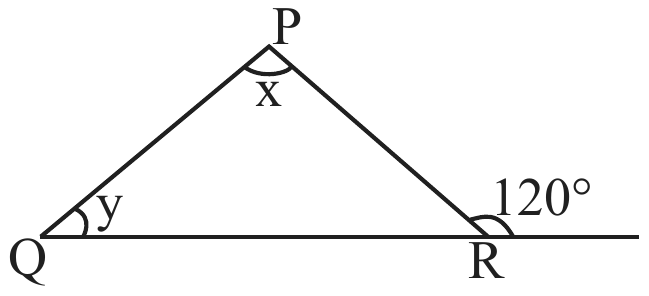
In the given figure, if ∠x – ∠y = 10°, then the value of ∠x will be :
(Figure: triangle PQR with base QR; ∠x is the angle at P and ∠y the angle at Q; QR is extended beyond R, and the exterior angle at R is 120°.)
(1)55°
(2)65°✓ Correct answer
(3)70°
(4)100°
Explanation
An exterior angle equals the sum of the two interior opposite angles, so x + y = 120°. With x − y = 10°, x = 65° and y = 55°; 55° is ∠y.
Q120 · Mathematics
The value of ∛(7/875) is :
(1)1/15
(2)1/4
(3)1/7
(4)1/5✓ Correct answer
Explanation
7/875 = 1/125 and ∛(1/125) = 1/5, since 5³ = 125. 1/15 cannot be right, since (1/15)³ = 1/3375, not 1/125.
Q121 · Science
At the time of short circuit, the current in the circuit
(1)Reduces substantially
(2)Varies continuously
(3)Increases heavily✓ Correct answer
(4)Does not change
Explanation
In a short circuit the live and neutral wires touch, the resistance becomes almost zero and, by I = V/R, the current rises sharply; a fuse or MCB is used to cut it off. The current cannot fall, since the resistance falls.
Q122 · Science
Chemical formula of aluminium oxide is
(1)AlO₂
(2)AlO₃
(3)Al₂O₃✓ Correct answer
(4)Al₃O₂
Explanation
Aluminium has valency 3 and oxygen valency 2; crossing the valencies gives Al₂O₃ (2 × 3 = 3 × 2 = 6). Al₃O₂ crosses them the wrong way round.
Q123 · Science
Which is the main National Park situated in West Bengal ?
(1)Sundarban National Park✓ Correct answer
(2)Gir National Park
(3)Kajiranga National Park
(4)Bandipur National Park
Explanation
Sundarban National Park in the Ganga–Brahmaputra delta of West Bengal is a tiger reserve and UNESCO World Heritage Site known for mangroves. Kajiranga (one-horned rhinoceros) is in Assam, Gir in Gujarat and Bandipur in Karnataka.
Q124 · Science
The variety of Brassica, resistance to “White rust” disease is
(1)Pusa Komal
(2)Pusa Shubhra
(3)Pusa Sadabahar
(4)Pusa Swarnim✓ Correct answer
Explanation
NCERT Class 12 Biology (plant breeding for disease resistance) lists Brassica variety Pusa Swarnim (Karan rai) as resistant to white rust. Pusa Shubhra is a cauliflower variety resistant to black rot, and Pusa Komal a cowpea resistant to bacterial blight.
Q125 · Science
Which was first described nucleus as a cell organelle ?
(1)Leeuwen Hoek
(2)Robert Hooke
(3)Robert Brown✓ Correct answer
(4)Camilio Golgi
Explanation
Robert Brown described the nucleus in orchid cells in 1831. Robert Hooke first saw and named cells (cork, 1665), and Camillo Golgi described the Golgi apparatus (1898).
Q126 · Science
The main feature of objective test is
(1)Not possible in all subjects
(2)Disregard for original thinking
(3)The effect of estimation
(4)High level of reliability and validity✓ Correct answer
Explanation
Objective tests have fixed answers scored the same by any examiner and can cover the whole syllabus, giving high reliability and validity. Neglect of original thinking and guessing are their known drawbacks, not merits.
Q127 · Science
Which of the following is not an example of homogeneous mixture ?
(1)Sulphur in carbon disulphide
(2)Sugar in water
(3)Ethanol in water
(4)Oil in water✓ Correct answer
Explanation
Oil does not dissolve in water and forms a separate layer, so it is a heterogeneous mixture. Sulphur dissolves in carbon disulphide and ethanol mixes fully with water, giving uniform solutions.
Q128 · Science
A Force (F) is acting on an area (A), if the force is halved and area is doubled then how much will be the pressure to the initial pressure ?
(1)Four times
(2)One forth✓ Correct answer
(3)Half
(4)Double
Explanation
Pressure P = F/A, so the new pressure is (F/2)/(2A) = P/4, one-fourth. Halving only the force would give half.
Q129 · Science
Which of the following compound is not a member of alkene homologous series ?
(1)C₅H₁₀
(2)C₄H₈
(3)C₃H₆
(4)C₂H₂✓ Correct answer
Explanation
Alkenes have the general formula CₙH₂ₙ (C₂H₄, C₃H₆, C₄H₈, C₅H₁₀). C₂H₂ (ethyne, acetylene) fits CₙH₂ₙ₋₂, so it is an alkyne.
Q130 · Science
In which year the central government made the “Biodiversity Act” ?
(1)2000
(2)2002✓ Correct answer
(3)2012
(4)2022
Explanation
The Biological Diversity Act was passed in 2002, giving effect to India's commitments under the Convention on Biological Diversity; it set up the National Biodiversity Authority (2003) at Chennai. It was amended in 2023, which is why later years are tempting.
Q131 · Science
An example of biodegradable waste is
(1)Plastic
(2)Metal
(3)Glass
(4)Cotton✓ Correct answer
Explanation
Cotton is a natural plant fibre (cellulose) that bacteria and fungi break down, so it is biodegradable. Plastic, glass and metal are not decomposed by microbes in any useful time.
Q132 · Science
Which of the following scale is used for the measurement of magnitude of the power of an earthquake ?
(1)Kelvin scale
(2)Decibel scale
(3)Pascal scale
(4)Richter scale✓ Correct answer
Explanation
Earthquake magnitude is given on the Richter scale, recorded by a seismograph; each whole number up means about 32 times more energy. The decibel measures loudness of sound and kelvin measures temperature.
Q133 · Science
The motion of an object is said to be uniform circular motion, if the object
(1)Moves on a circular path with variable speed
(2)Moves on a circular path with constant acceleration
(3)Moves on a circular path with constant speed✓ Correct answer
(4)Moves on a circular path with constant velocity
Explanation
In uniform circular motion the speed stays constant but the direction keeps changing, so the velocity is not constant and the motion is accelerated (centripetal acceleration). Constant velocity is possible only in a straight line.
Q134 · Science
Disease caused by deficiency of Vitamin – C (Ascorbic acid) is
(1)Rickets
(2)Scurvy✓ Correct answer
(3)Beri-Beri
(4)Night-blindness
Explanation
Lack of vitamin C causes scurvy, with bleeding gums and slow healing of wounds; citrus fruits and amla prevent it. Rickets is due to vitamin D, beri-beri to vitamin B1 and night-blindness to vitamin A.
Q135 · Science
Founder of the heuristic method of biology teaching
(1)H. E. Armstrong✓ Correct answer
(2)John Dewey
(3)William Kilpatrick
(4)C. V. Good
Explanation
H. E. Armstrong introduced the heuristic method, in which the pupil is put in the place of a discoverer and finds things out by experiment. Kilpatrick, a follower of Dewey, developed the project method.
Q136 · Science
A man is standing 6 metre away from a plane mirror. The distance between the man and its image in metre will be :
(1)12✓ Correct answer
(2)3
(3)6
(4)7.5
Explanation
A plane mirror forms the image as far behind it as the object is in front, 6 m, so man and image are 6 + 6 = 12 m apart. 6 m is only the image's distance from the mirror.
Q137 · Science
The acid found in nettle’s sting is
(1)Lactic acid
(2)Citric acid
(3)Methanoic acid✓ Correct answer
(4)Tartaric acid
Explanation
Nettle leaves have stinging hairs that inject methanoic (formic) acid, the same acid as in an ant's sting; a traditional remedy is rubbing the spot with a leaf of the dock plant. Lactic acid is in curd and tartaric acid in tamarind.
Q138 · Science
Secretion of which gland also helps in lubrication of penis in man ?
(1)Pineal gland
(2)Thymus gland
(3)Adrenal gland
(4)Bulbourethral gland✓ Correct answer
Explanation
The bulbourethral (Cowper's) glands are male accessory glands whose mucus lubricates the urethra and the penis. Pineal, thymus and adrenal glands are endocrine glands, not reproductive accessory glands.
Q139 · Science
How many decibel (dB) is safe noise level fixed by the World Health Organisation for a city ?
(1)140 dB
(2)90 dB
(3)65 dB
(4)45 dB✓ Correct answer
Explanation
As per BSER's final key, the WHO safe noise level for a city is 45 dB (WHO guidance has long used about 45 dB for night-time and quiet areas). Sound above about 80 dB is harmful to hearing, and 140 dB is near the threshold of pain.
Q140 · Science
Which is not an example of sexually transmitted disease ?
(1)Gonorrhoea
(2)Syphilis
(3)Genital harpes
(4)T. B.✓ Correct answer
Explanation
Tuberculosis is caused by Mycobacterium tuberculosis and spreads through droplets in the air, not by sexual contact. Gonorrhoea, syphilis (both bacterial) and genital herpes (viral) are sexually transmitted infections.
Q141 · Science
Two forces of 5 N and 3 N are acting on the same object in opposite directions, the resultant force on the object will be
(1)15 N
(2)8 N
(3)0.6 N
(4)2 N✓ Correct answer
Explanation
Forces in opposite directions subtract: 5 N − 3 N = 2 N, acting in the direction of the larger force. 8 N would be the resultant if both acted in the same direction.
Q142 · Science
Mode of reproduction in Leishmania is
(1)Budding
(2)Regeneration
(3)Binary fission✓ Correct answer
(4)Multiple fission
Explanation
Leishmania (the protozoan causing kala-azar) reproduces by binary fission, and because of its whip-like flagellum the division is longitudinal, as NCERT Class 10 notes. Multiple fission is seen in Plasmodium, the malaria parasite.
Q143 · Science
Inductive method is based on the following teaching maxims
(1)From rule to example
(2)From known to unknown✓ Correct answer
(3)From general to specific
(4)From evidence to direct
Explanation
As per BSER's final key, the answer is 'known to unknown'. The inductive method starts from examples pupils know and observe and leads to a new general rule, following the maxims 'known to unknown', 'concrete to abstract' and 'particular to general'. 'Rule to example' and 'general to specific' describe the deductive method.
Q144 · Science
When the glass rod is rubbed with the silk cloth, then glass rod will become
(1)Electrically neutral
(2)Positively charged✓ Correct answer
(3)Negatively charged
(4)None of the above
Explanation
On rubbing, glass loses electrons to silk, so the glass rod becomes positively charged and the silk equally negatively charged. A plastic or ebonite rod rubbed with wool becomes negatively charged.
Q145 · Science
Deleted by BSER — marks given to all
Example of pulses crop is
(1)Wheat
(2)Sugarcane
(3)Sorghum
(4)Groundnut
Explanation
BSER's final key drops this question (bonus, marks to all). None of the options is a pulse: wheat and sorghum are cereals, sugarcane is a cash crop, and groundnut, though a legume, is grown and classed as an oilseed.
Q146 · Science
Pitch of a given sound depends upon
(1)Wavelength
(2)Frequency✓ Correct answer
(3)Amplitude
(4)Intensity
Explanation
Pitch (shrillness) depends on frequency: the higher the frequency, the higher the pitch, which is why a woman's voice is usually shriller than a man's. Loudness depends on amplitude.
Q147 · Science
Match the following :
1. Elephantiasis | a. Rhino virus
2. Amoebiasis | b. Haemophillus influenzae
3. Pneumonia | c. W. Bancrofti
4. Common cold | d. A. Histolytica
(1)1 – d, 2 – c, 3 – a, 4 – b
(2)1 – c, 2 – d, 3 – b, 4 – a✓ Correct answer
(3)1 – a, 2 – b, 3 – c, 4 – d
(4)1 – b, 2 – a, 3 – d, 4 – c
Explanation
Elephantiasis (filariasis) is caused by the worm Wuchereria bancrofti, amoebiasis by Entamoeba histolytica, pneumonia by bacteria such as Haemophilus influenzae and Streptococcus pneumoniae, and the common cold by rhinoviruses (NCERT Class 12, Human Health and Disease).
Q148 · Science
The fuel having lowest calorific value in kJ/kg unit is
(1)Coal✓ Correct answer
(2)Petrol
(3)LPG
(4)Hydrogen
Explanation
Approximate calorific values (NCERT Class 8): coal 25,000–33,000 kJ/kg, petrol 45,000, LPG 55,000 and hydrogen 150,000 kJ/kg, so coal is the lowest. Hydrogen has the highest calorific value of all fuels.
Q149 · Science
The best way to control global warming is
(1)By increasing use of fossil fuel
(2)By reducing the emission of greenhouse gases✓ Correct answer
(3)By increasing deforestation
(4)By reducing plantation
Explanation
Global warming is driven by greenhouse gases (CO₂, methane, nitrous oxide) trapping heat, so cutting their emissions is the main remedy. Burning more fossil fuel, cutting forests and planting fewer trees all raise CO₂.
Q150 · Science
Which of the following is not a characteristic of a good evaluation ?
(1)Validity
(2)Continuity
(3)Reliability
(4)Narrow mindedness✓ Correct answer
Explanation
Good evaluation is valid, reliable, continuous and comprehensive, covering all aspects of the learner. Narrowness is the opposite of comprehensiveness, so it is not a characteristic.
Questions 91–150: Social Studies
Q91 · Social Studies
Who was the 23rd Tirthankara of Jainism ?
(1)Rishabhdev
(2)Parshvanath✓ Correct answer
(3)Neminath
(4)Mahavira Swami
Explanation
Parshvanath, a prince of Kashi, was the 23rd Tirthankara; he taught four vows, and Mahavira added brahmacharya as the fifth. Mahavira was the 24th and last Tirthankara, and Rishabhdev the first.
Q92 · Social Studies
Which of the following centre was not the main political centre of the Maurya Empire ?
(1)Taxila
(2)Ujjayini
(3)Kaushambi✓ Correct answer
(4)Suvarnagiri
Explanation
Besides the capital Pataliputra, Ashoka's inscriptions name provincial centres at Taxila (north-west), Ujjayini (west), Suvarnagiri (south) and Tosali (east). Kaushambi was an important city, but not one of these provincial capitals.
Q93 · Social Studies
El – Nino generally originates in the month of
(1)December✓ Correct answer
(2)March
(3)May
(4)September
Explanation
El Nino is a warm current that appears off the coast of Peru around Christmas, so it usually begins in December ('El Nino' means 'the Christ child'). It often weakens the Indian monsoon.
Q94 · Social Studies
Why should local knowledge be incorporated into the social science curriculum ?
(1)To encourage memorization of local facts and figures for exams
(2)To focus exclusively on the traditions of a specific community
(3)To relate the curriculum to students real world environment and make learning meaningful✓ Correct answer
(4)To replace text books entirely with community based discussions
Explanation
NCF 2005 asks that school knowledge be linked to life outside school, and local knowledge lets children connect social science to the world they know. It adds to the textbook, not replaces it, and it is not meant for memorising facts.
Q95 · Social Studies
Match the following shifting agriculture and their region :
Shifting agriculture - Region
(1) Bewar - (a) Madhya Pradesh
(2) Podu - (b) Andhra Pradesh
(3) Kumari - (c) Western Ghats
(4) Valre - (d) South Eastern Rajasthan
NCERT's list of local names for slash-and-burn farming gives Bewar or Dahiya in Madhya Pradesh, Podu or Penda in Andhra Pradesh, Kumari in the Western Ghats and Valre or Waltre in south-eastern Rajasthan. In the north-east it is called Jhumming.
Q96 · Social Studies
Which of the following buildings is not located in the Chittor Fort ?
(1)Bhamashah’s Haveli
(2)Sringar Chanvri Palace
(3)Navlakha Bhandar
(4)Supari Mahal✓ Correct answer
Explanation
Chittorgarh fort holds Bhamashah's Haveli, the Navlakha Bhandar (treasury) and the Shringar Chanvri (a small shrine of Kumbha's reign, 1448), along with the Vijay Stambh and Kirti Stambh. That Supari Mahal is the building not in the fort follows BSER's final key.
Q97 · Social Studies
According to the Indian Constitution, the State legislature cannot make laws on which of the following subjects ?
(1)Agriculture
(2)Ports✓ Correct answer
(3)Land
(4)Public health
Explanation
Major ports are in the Union List of the Seventh Schedule, so only Parliament can make laws on them. Ports other than major ports are in the Concurrent List (entry 31), where States may also legislate; the key still treats 'ports' as the Union subject, since the other three options are clearly State subjects. Agriculture, land and public health are in the State List.
Q98 · Social Studies
With whom were Masru, Mir-e-Badla and Naurangshahi related ?
(1)Name of utensils
(2)Many types of clothes for women’s✓ Correct answer
(3)Types of jewellery
(4)Types of musical ragas
Explanation
Masru, Mir-e-Badla and Naurangshahi are kinds of fabric worn by women in Rajasthan, made into the odhni, ghaghra and kanchli. They are not ornaments: Rajasthani women's jewellery has names like borla, timaniya and hansli.
Q99 · Social Studies
In which Schedule were 29 subjects added for Panchayati Raj by the 73rd Constitutional Amendment in the Indian Constitution ?
(1)9th
(2)10th
(3)11th✓ Correct answer
(4)12th
Explanation
The 73rd Amendment (1992) added Part IX and the 11th Schedule with 29 subjects for panchayats. The 74th Amendment added the 12th Schedule with 18 subjects for municipalities.
Q100 · Social Studies
Which Prajamandal was associated with Sagarmal Gopa ?
(1)Bharatpur
(2)Udaipur
(3)Jaipur
(4)Jaisalmer✓ Correct answer
Explanation
Sagarmal Gopa led the freedom movement in Jaisalmer; he was jailed under Maharawal Jawahar Singh and burnt to death in prison in April 1946. His book 'Jaisalmer ka Gunda Raj' attacked the state's rule.
Q101 · Social Studies
Who composed the story collection ‘Sapna Priya’ ?
(1)Shivchandra Bhartiya
(2)Yadvendra Sharma Chandra
(3)Vijaydan Detha✓ Correct answer
(4)Nathmal Joshi
Explanation
The English question prints the title as 'Sapna Priya' and the Hindi as 'सपन प्रिया' (Sapan Priya). That it is by Vijaydan Detha 'Bijji' of Borunda, the Rajasthani storyteller best known for the folk-tale series 'Baatan ri Phulwari', follows BSER's final key. Shivchandra Bhartiya wrote 'Kanak Sundar', the first Rajasthani novel.
Q102 · Social Studies
What is the angle between the axis of the earth and its orbital plane ?
(1)23½°
(2)66½°✓ Correct answer
(3)90°
(4)85°
Explanation
The earth's axis makes 66½° with the plane of its orbit. 23½° is the axis's tilt from the perpendicular to that plane, the angle that gives the tropics and the seasons.
Q103 · Social Studies
What was the ancient name of ‘Java’ ?
(1)Yavadweep✓ Correct answer
(2)Suvarnadweep
(3)Varunadweep
(4)Lakshadweep
Explanation
Indian texts called Java 'Yavadvipa' (island of barley), a name also in the Ramayana. Suvarnadvipa usually meant Sumatra and the Malay region, and Varunadvipa was Borneo.
Q104 · Social Studies
Which of the following pairs is not correctly matched ?
Festival - Place
(1)Marwar festival – Jodhpur
(2)Thar festival – Bikaner✓ Correct answer
(3)Maru festival – Jaisalmer
(4)Elephant festival – Jaipur
Explanation
The Thar Festival is held at Barmer; Bikaner hosts the Camel Festival. Marwar Festival (Jodhpur), Desert or Maru Festival (Jaisalmer) and the Elephant Festival on Holi eve (Jaipur) are correctly matched.
Q105 · Social Studies
What is the primary purpose of the 5E model in teaching social sciences ?
(1)To encourage active learning and engagement✓ Correct answer
(2)To memorize historical events
(3)To focus on rote learning techniques
(4)To prioritize lecture based instruction
Explanation
The 5E model (Engage, Explore, Explain, Elaborate, Evaluate) is a constructivist plan in which learners build ideas through activity. Lecturing or rote memorising goes against its exploration-first design.
Q106 · Social Studies
The nearest point on earth surface from focus, is known as
(1)Hypocentre
(2)Shadow zone
(3)Tectonic centre
(4)Epicentre✓ Correct answer
Explanation
The focus (hypocentre) is the point inside the earth where an earthquake starts; the point on the surface directly above it is the epicentre, which feels the waves first. The shadow zone is where certain waves do not reach.
Q107 · Social Studies
Consider the following statements about Dashavatara temple of Deogarh :
1. This temple is located in the state of Uttar Pradesh.
2. The temple has been constructed on a high and wide platform.
3. This temple is the first example of a Shikhara Mandir.
Which of the statements given above is/are true ?
(1)Only 1
(2)1, 2
(3)1, 3
(4)1,2,3✓ Correct answer
Explanation
The Gupta-period Dashavatara temple at Deogarh (Lalitpur district, Uttar Pradesh) stands on a high, wide plinth, so statements 1 and 2 are true. It is often described as the earliest known north Indian temple with a shikhara (now ruined); taking statement 3 as true, and so all three, follows BSER's final key. It is a Vishnu temple with the Sheshashayi Vishnu panel.
Q108 · Social Studies
What are the two major types of rubrics ?
(1)Objective and subjective rubrics
(2)Summative and formative rubrics
(3)Holistic and analytic rubrics✓ Correct answer
(4)Diagnostic and evaluative rubrics
Explanation
A holistic rubric gives one overall score for a piece of work, while an analytic rubric scores each criterion (content, organisation, sources) separately. Formative and summative are kinds of assessment, not kinds of rubric.
Q109 · Social Studies
Who gave shelter to Peshwa Nana Saheb and his family in Rajasthan during the Revolution of 1857 ?
(1)Thakur Kushal Singh of Auwa
(2)Rawat Jyot Singh of Kothariya✓ Correct answer
(3)Maharaja Takhat Singh of Bharatpur
(4)Maharana Swarup Singh of Udaipur
Explanation
Rawat Jodh (Jyot) Singh of Kothariya in Mewar sheltered Nana Saheb and his family. Thakur Kushal Singh of Auwa led the revolt in Marwar against the Jodhpur and British forces, and Maharana Swarup Singh sided with the British.
Q110 · Social Studies
The Parliament passed the ‘Indian Post Office (Amendment) Bill’ and presented to which President for signature ?
(1)Gyani Zail Singh✓ Correct answer
(2)Neelam Sanjeeva Reddy
(3)Dr. Shankar Dayal Sharma
(4)V. V. Giri
Explanation
In 1986 President Zail Singh neither signed nor returned the Indian Post Office (Amendment) Bill, the famous use of the 'pocket veto', since Article 111 sets no time limit for assent. The Bill was later withdrawn.
Q111 · Social Studies
In which Article of the Indian Constitution, the Fundamental Duties are described ?
(1)50 A
(2)51 A✓ Correct answer
(3)52 A
(4)53 A
Explanation
The 42nd Amendment (1976) added Part IVA with Article 51A, on the Swaran Singh Committee's advice; it now lists 11 duties after the 86th Amendment. Article 50 is the Directive Principle on separating the judiciary from the executive.
Q112 · Social Studies
Which Dam is located in Madhya Pradesh ?
(1)Gandhi Sagar✓ Correct answer
(2)Rana Pratap Sagar
(3)Jawahar Sagar
(4)Kota Barrage
Explanation
Of the four dams of the Chambal valley project, Gandhi Sagar (Mandsaur district) is in Madhya Pradesh. Rana Pratap Sagar (Rawatbhata), Jawahar Sagar and the Kota Barrage are in Rajasthan.
Q113 · Social Studies
According to Article 334, how many seats are reserved for Scheduled Castes in Lok Sabha ? (Till Dec. 2024)
(1)30
(2)47
(3)63
(4)84✓ Correct answer
Explanation
Of the 543 Lok Sabha seats, 84 are reserved for Scheduled Castes and 47 for Scheduled Tribes (reservation itself is under Article 330). Article 334 sets how long this reservation lasts, now extended to 2030 by the 104th Amendment.
Q114 · Social Studies
Which of the following is an example of a cultural resource in the community ?
(1)Hills and Valleys
(2)Art theatres, museums and radio stations✓ Correct answer
(3)Police stations and Municipal offices
(4)Mines and factories
Explanation
Theatres, museums and radio stations carry a community's art and heritage, so a social science teacher can use them as cultural resources. Hills and valleys are natural resources, and police stations and municipal offices are civic or administrative ones.
Q115 · Social Studies
Women painters named Kamala and Elaichi are associated to which painting style of Rajasthan ?
(1)Jodhpur style
(2)Kishangarh style
(3)Nathdwara style✓ Correct answer
(4)Bundi style
Explanation
Kamala and Ilaichi were women painters of the Nathdwara school of Mewar, known for pichhwai paintings of Shrinathji. Kishangarh is known for Nihalchand's 'Bani Thani', not for these women artists.
Q116 · Social Studies
Where are the Central Arid Zone Research Institute and Arid Forest Research Institute located ?
(1)Bikaner
(2)Jodhpur✓ Correct answer
(3)Jaisalmer
(4)Nagaur
Explanation
CAZRI (ICAR, 1959) and AFRI (ICFRE, 1988) are both in Jodhpur. Bikaner has national research centres on the camel and on arid horticulture.
Q117 · Social Studies
What were the copper coins called during the Mauryan period ?
(1)Nishka
(2)Karshapan
(3)Dharan
(4)Mashak✓ Correct answer
Explanation
Kautilya's Arthashastra names the copper coins of the period as the mashaka, half-mashaka and kakani; the silver punch-marked coin was the pana or karshapana (dharana was a silver weight), and the nishka was a gold coin or ornament. Karshapanas were also struck in copper, so choosing mashaka follows BSER's final key.
Q118 · Social Studies
What is the primary purpose of using narration as a teaching strategy in social sciences ?
(1)To replace textbooks with storytelling
(2)To focus only on historical facts
(3)To reduce the role of student participation
(4)To present a well ordered and engaging verbal account of events✓ Correct answer
Explanation
Narration (story-telling) presents events in a clear order and a lively way, which suits history in the middle classes and holds attention. It supports the textbook rather than replacing it.
Q119 · Social Studies
Match the List – I with List – II :
List – I (Archaeological Site) - List – II (Structure)
1. Banawali - i. Traces of canals
2. Kalibanga - ii. Terracotta models of the plough
3. Shortughai - iii. Ploughed field
4. Dholavira - iv. Use of reservoirs
Select the correct answer using the code given below :
(1)1-i, 2-ii, 3-iii, 4-iv
(2)1-iv, 2-iii, 3-ii, 4-i
(3)1-ii, 2-iii, 3-iv, 4-i
(4)1-ii, 2-iii, 3-i, 4-iv✓ Correct answer
Explanation
NCERT's Class 12 history text names these finds: terracotta plough models at Banawali (Haryana), a ploughed field at Kalibangan (Rajasthan), traces of canals at Shortughai (Afghanistan) and water reservoirs at Dholavira (Gujarat). Canals are not reported from Dholavira, which stored water in tanks.
Q120 · Social Studies
When did Mangal Pandey revolt in Barrackpur ?
(1)28 May 1857
(2)10 May 1857
(3)29 March 1857✓ Correct answer
(4)8 April 1857
Explanation
Mangal Pandey of the 34th Bengal Native Infantry attacked his officers at Barrackpur on 29 March 1857 and was hanged on 8 April 1857. The revolt proper began at Meerut on 10 May 1857, and in Rajasthan at Nasirabad on 28 May 1857.
Q121 · Social Studies
The coriolis force which deflects the directions of the winds on the earth, is maximum at
(1)Equator
(2)Mid-latitudes
(3)Poles✓ Correct answer
(4)Same on the earth
Explanation
The Coriolis force grows with the sine of latitude, so it is greatest at the poles and zero at the equator. That is why tropical cyclones do not form right on the equator.
Q122 · Social Studies
On the banks of which river the “Dashragya battle” was fought during the Rigvedic times ?
(1)Shatudri
(2)Vipasa
(3)Vitasta
(4)Parushni✓ Correct answer
Explanation
The Battle of Ten Kings, told in the 7th mandala of the Rigveda, was fought on the Parushni (Ravi), where Sudas of the Bharatas defeated a confederacy of ten tribes. Shatudri is the Sutlej, Vipasa the Beas and Vitasta the Jhelum.
Q123 · Social Studies
Which of the following is not an example of a project work in social sciences ?
(1)Collection of postal stamps
(2)Running a cooperative bank
(3)Solving mathematical equations✓ Correct answer
(4)Organizing social surveys
Explanation
A project is a purposeful, real-life task that pupils plan and carry out, like a stamp collection, a school cooperative bank or a social survey. Solving equations is a mathematics exercise, not a social science project.
Q124 · Social Studies
Khadar and Bhangar are examples of which soil in India ?
(1)Black
(2)Red-yellow
(3)Arid
(4)Alluvial✓ Correct answer
Explanation
Alluvial soil is divided into khadar, the new, fertile alluvium of floodplains, and bhangar, the older alluvium on higher ground with kankar nodules. Black soil is the regur of the Deccan lava plateau.
Q125 · Social Studies
Who composed the ‘Prayag Prashasti’ famous as the Allahabad Pillar Inscription ?
(1)Harishena✓ Correct answer
(2)Kalidasa
(3)Shudrak
(4)Bhas
Explanation
Harishena, the court poet of Samudragupta, composed the Prayag Prashasti in Sanskrit on an Ashokan pillar; it records Samudragupta's conquests. Kalidasa, of Chandragupta II's time, wrote Abhijnanashakuntalam.
Q126 · Social Studies
Which aspect is considered critical while planning instructional objectives ?
(1)Use of action verbs✓ Correct answer
(2)Memorization of textbook content
(3)Avoiding precise goals
(4)Ignoring evaluation methods
Explanation
Instructional objectives are written in behavioural terms with observable action verbs (identify, compare, locate) so that learning can be seen and assessed. Vague goals or ignoring evaluation defeat the purpose of an objective.
Q127 · Social Studies
In Rajasthan Kamalital and Rajeshwari are related with
(1)Coal
(2)Mineral oil and natural gas✓ Correct answer
(3)Nuclear energy
(4)Copper
Explanation
Kamalital (Jaisalmer basin) and Rajeshwari (Barmer basin) are oil and gas fields of western Rajasthan, where the Mangala, Bhagyam and Aishwariya oil fields also lie. Rajasthan's lignite comes from places like Palana, Giral and Kapurdi.
Q128 · Social Studies
When did the ‘Protection of Women from Domestic Violence Act’ come into force ?
(1)2002
(2)2004
(3)2006✓ Correct answer
(4)2008
Explanation
The Protection of Women from Domestic Violence Act was passed in 2005 and came into force on 26 October 2006. It covers physical, sexual, verbal, emotional and economic abuse, so 2005 (passing) and 2006 (in force) should not be confused.
Q129 · Social Studies
Who was first to report Kalibanga Civilization ?
(1)Amalananda Ghosh✓ Correct answer
(2)Akshay Kirti Vyas
(3)Ratan Chandra Agrawal
(4)Vijay Kumar
Explanation
Amalananda Ghosh identified Kalibangan on the Ghaggar in Hanumangarh as a Harappan site in 1952. The Italian scholar L. P. Tessitori had noted the mound earlier (1917–19), but Ghosh first recognised it as Harappan. B.B. Lal and B.K. Thapar excavated it later (1961–69); Ratan Chandra Agrawal is linked with the Ahar excavation.
Q130 · Social Studies
The correct sequence of physiographic features from North to South is
(1)Vindhya range – Satpura range – Mahadeo hills✓ Correct answer
(2)Satpura range – Vindhya range – Mahadeo hills
(3)Mahadeo hills – Satpura range – Vindhya range
(4)Mahadeo hills – Vindhya range – Satpura range
Explanation
The Vindhyas lie north of the Narmada and the Satpuras south of it, between the Narmada and the Tapi, so Vindhya comes before Satpura. The Mahadeo hills (Pachmarhi, with Dhupgarh) are part of the Satpura system itself; placing them last, after the Satpura, follows BSER's final key.
Q131 · Social Studies
When was Guru Nanak born ?
(1)1398
(2)1469✓ Correct answer
(3)1498
(4)1569
Explanation
Guru Nanak, founder of Sikhism, was born in 1469 at Talwandi (now Nankana Sahib, Pakistan) and died at Kartarpur in 1539. 1398 is the traditional birth year of Kabir.
Q132 · Social Studies
What are the three mutually interrelated aspects of the evaluation process ?
(1)Objectives, Resources and Tools
(2)Planning, Implementation and Objectives
(3)Objectives, Learning experiences and Evaluation✓ Correct answer
(4)Teaching, Testing and Learning
Explanation
B.S. Bloom's evaluation triangle links educational objectives, learning experiences and evaluation (behaviour change): each shapes the other two. Teaching, testing and learning is a loose description, not the standard triangle.
Q133 · Social Studies
Settlement of dispute between two States in India falls under which jurisdiction of the Supreme Court ?
(1)Advisory
(2)Original✓ Correct answer
(3)Appellate
(4)Writ
Explanation
Under Article 131, disputes between the Centre and states, or between states, go straight to the Supreme Court in its original jurisdiction. Advisory jurisdiction (Article 143) is when the President seeks its opinion.
Q134 · Social Studies
Which is the largest producer state of millets in India ?
(1)Rajasthan✓ Correct answer
(2)Punjab
(3)Haryana
(4)Gujarat
Explanation
Rajasthan leads India in millet output, mainly bajra (pearl millet), grown on its dry sandy soils with little rain. Punjab and Haryana are leading wheat and rice states.
Q135 · Social Studies
How many members of the Constituent Assembly signed the Constitution of India, adopted on 26 November 1949 ?
(1)389
(2)299
(3)284✓ Correct answer
(4)278
Explanation
284 members signed the Constitution on 24 January 1950. The Assembly was planned with 389 members and had 299 after Partition.
Q136 · Social Studies
Which of the following is/are principles of Arya Samaj ?
1. Vedas are the storehouse of truth, knowledge and wisdom.
2. Idol worship is hypocrisy.
3. Opposed to widow remarriage.
4. Opposed to incarnationalism.
(1)1, 2, 3
(2)1, 3, 4
(3)1, 4
(4)1, 2, 4✓ Correct answer
Explanation
Swami Dayanand Saraswati founded the Arya Samaj in 1875 on the Vedas as the source of true knowledge, rejecting idol worship and the doctrine of incarnations. The Samaj supported widow remarriage, so statement 3 is wrong.
Q137 · Social Studies
By which Constitutional Amendment the voting age was reduced from 21 to 18 years in India ?
(1)60th
(2)61st✓ Correct answer
(3)62nd
(4)63rd
Explanation
The 61st Amendment Act, 1988 (in force 1989) amended Article 326 to lower the voting age from 21 to 18. The 52nd Amendment (1985) is the anti-defection law.
Q138 · Social Studies
Which of the following statement is/are correct about Magadha Mahajanapada ?
1. Anga was assimilated into Magadha by Bimbisara.
2. Avanti was assimilated into Magadha by Udayin.
3. Vajjisangh was assimilated into Magadha by Ajatashatru.
(1)1, 2
(2)2, 3
(3)1, 3✓ Correct answer
(4)1, 2, 3
Explanation
Bimbisara annexed Anga, and Ajatashatru conquered the Vajji confederacy (Vaishali), so 1 and 3 are true. Avanti was absorbed by Shishunaga, not Udayin; Udayin is known for founding Pataliputra.
Q139 · Social Studies
Which concept introduced by social networking is analogous to live radio and television broadcast ?
(1)User privacy setting
(2)Real-time web✓ Correct answer
(3)Group messaging
(4)Content scheduling
Explanation
The real-time web shows posts and live streams the moment they happen, just as live radio and TV carry events as they occur. Content scheduling is the opposite: posts are set to appear later.
Q140 · Social Studies
The correct group of metallic minerals is
(1)Iron, Copper, Mica
(2)Mica, Potash, Iron
(3)Iron, Copper, Lead✓ Correct answer
(4)Iron, Copper, Potash
Explanation
Iron is a ferrous metallic mineral, and copper and lead are non-ferrous metallic minerals. Mica and potash are non-metallic minerals, which rules out the other three groups.
Q141 · Social Studies
Which of the following statements is not correct ?
(1)Ursa major or Big Bear is a constellation.
(2)Very Big and hot celestial bodies made up of gases, having own heat and light, are called stars.
(3)Jupiter, Saturn, Uranus, Neptune are inner planets.✓ Correct answer
(4)The shape of Earth is called ‘Geoid’.
Explanation
Jupiter, Saturn, Uranus and Neptune are the outer (Jovian) planets, beyond the asteroid belt. The inner, rocky planets are Mercury, Venus, Earth and Mars; the other three statements are true.
Q142 · Social Studies
Which Guhil ruler has been compared by historian C. V. Vaidya with French Commander Charles Martel ?
(1)Bappa Rawal✓ Correct answer
(2)Maharana Kumbha
(3)Rana Hammir
(4)Rana Sanga
Explanation
C.V. Vaidya likened Bappa Rawal to Charles Martel, who stopped the Arab advance into France at Tours (732), because Bappa resisted the Arab invaders in the 8th century. Bappa Rawal is linked with taking Chittor and with the Eklingji temple.
Q143 · Social Studies
What was the main content of ‘Zij-e-Shahjahani’ ?
(1)Anatomy
(2)Painting
(3)Astronomy✓ Correct answer
(4)Arithmetic
Explanation
A 'zij' is an astronomical table; the Zij-e-Shahjahani of Shah Jahan's reign gave tables of planetary positions. Sawai Jai Singh's later 'Zij-i-Muhammadshahi' is a similar work linked to the Jantar Mantars.
Q144 · Social Studies
Which of the following theory is not related to Buddhism ?
(1)Atheism
(2)Spiritism✓ Correct answer
(3)Karmvaad
(4)Reincarnationism
Explanation
Buddhism teaches anatta (no permanent soul), so 'atmavada' is not part of it. It does accept karma and rebirth and does not rely on a creator God, which is why it is called anishvaravadi.
Q145 · Social Studies
The Fundamental Right in which ‘Child Protection and Child Rights’ are given the most importance, is
(1)Right to Equality
(2)Right against Exploitation✓ Correct answer
(3)Right to Freedom of Religion
(4)Cultural and Educational Rights
Explanation
The Right against Exploitation includes Article 24, which bans employing children under 14 in factories, mines or hazardous work, along with Article 23 against trafficking. The right to education (Article 21A) sits under the Right to Freedom, not under Cultural and Educational Rights.
Q146 · Social Studies
Who founded the ‘Indian Home Rule League’ in April 1916 ?
(1)Mahatma Gandhi
(2)Sir Aga Khan
(3)Aurobindo Ghosh
(4)Bal Gangadhar Tilak✓ Correct answer
Explanation
Tilak set up the Indian Home Rule League at Belgaum in April 1916, working in Maharashtra and Karnataka. Annie Besant started the All India Home Rule League at Madras in September 1916.
Q147 · Social Studies
If it is 10.00 AM at a place located at 15° east longitude, then what will be the time at a place located at 75° east longitude ?
(1)02.00 PM✓ Correct answer
(2)02.00 AM
(3)10.00 PM
(4)06.00 AM
Explanation
The places are 60° apart, and each degree of longitude makes 4 minutes, so the difference is 240 minutes or 4 hours. A place further east is ahead in time, so 10 AM + 4 hours = 2 PM; 6 AM would be the answer for a place 60° to the west.
Q148 · Social Studies
Impressed by the miracles of which Saint, Delhi Sultan Sikandar Lodi gave him land in Rajasthan ?
(1)Jasnathji✓ Correct answer
(2)Mallinathji
(3)Gogaji
(4)Mehaji Manglia
Explanation
Sikandar Lodi gave land at Katariyasar (Bikaner) to Jasnathji, founder of the Jasnathi sect known for its fire dance. Mallinathji, the folk deity of Tilwara (Barmer), is linked with the Tilwara cattle fair.
Q149 · Social Studies
Where was the first cement factory established in Rajasthan ?
(1)Lakheri✓ Correct answer
(2)Beawar
(3)Nimbahera
(4)Chittorgarh
Explanation
Rajasthan's first cement factory was set up at Lakheri in Bundi district (1913–15, production from 1917), using local limestone. Chittorgarh and Nimbahera later became the state's main cement centres.
Q150 · Social Studies
What is the primary goal of studying social sciences ?
(1)To enhance physical skills
(2)To help students know, understand and adjust to their society and environment✓ Correct answer
(3)To develop mathematical models
(4)To analyze mechanical systems
Explanation
Social science studies people in society, so its main aim is to help learners understand their social and physical surroundings and take part in them as thoughtful citizens. Mathematical models and mechanical systems belong to maths and physics.
Questions: Board of Secondary Education, Rajasthan (Ajmer). Answers: BSER final answer key. Explanations: TopKaro.