In Hull’s formula for effective reaction potential, which symbol represents reaction inhibition ?
(1)sHr
(2)D
(3)V
(4)Ir✓ Correct answer
Explanation
In Hull's formula for effective reaction potential, Ir stands for reactive inhibition, the fatigue-like tendency that builds up with repeated responding and lowers performance. sHr is habit strength, D is drive and V is stimulus-intensity dynamism, which raise reaction potential instead of inhibiting it.
Q2 · Child Development & Pedagogy
How does Gardner suggest Schools should implement the theory of multiple intelligences ?
(1)Focus solely on linguistic and logical mathematical intelligence
(2)Train teachers to present lessons using diverse methods like art, music and role play✓ Correct answer
(3)Standardize IQ testing to identify intelligence types
(4)Limit the teaching methods to traditional classroom approaches
Explanation
Gardner held that each child has a different profile of intelligences, so teachers should present the same content through many entry points such as art, music, movement and role play. Focusing only on linguistic and logical-mathematical intelligence (A) is exactly the narrow schooling his theory criticises.
Q3 · Child Development & Pedagogy
What is the term for adopting someone else’s behavior or personality traits as one’s own ?
(1)Sublimation
(2)Identification✓ Correct answer
(3)Projection
(4)Compensation
Explanation
Identification is the defence mechanism in which a person takes on the behaviour or traits of an admired person as his own, as a child copying a favourite teacher. Projection (C) is the reverse: putting one's own unwanted feelings onto others.
Q4 · Child Development & Pedagogy
What is the primary feature of “Action Research” ?
(1)It is a dynamic process✓ Correct answer
(2)It is a theoretical process
(3)It avoids problem solving approaches
(4)It relies solely on self-evaluation
Explanation
Action research, introduced into education by Stephen Corey, is a dynamic cycle of plan, act, observe and reflect that a teacher uses to solve a real classroom problem. It is practical rather than theoretical (B), and it is itself a problem-solving approach, so (C) is the opposite of the truth.
Q5 · Child Development & Pedagogy
What indicates difficulty in understanding or remembering what was read ?
(1)Forgetting the book title
(2)Inability to recall basic facts from reading✓ Correct answer
(3)Reading with high fluency but low comprehension
(4)Excessive note-taking
Explanation
A reading-comprehension difficulty shows up when a child cannot recall the basic facts of what was just read, even after decoding the words. Forgetting the title (A) is trivial; reading fluently with low comprehension (C) is one form of the problem, but the key takes the inability to recall basic facts as its clearest sign.
Q6 · Child Development & Pedagogy
Which of the following is not included in the Guilford’s three basic parameters of the structure of human intelligence ?
(1)Specific factors✓ Correct answer
(2)Contents
(3)Products
(4)Operations
Explanation
Guilford's Structure of Intellect model has three dimensions: contents, operations and products (5 × 6 × 6 = 180 abilities in the later version). 'Specific factors' belong to Spearman's two-factor theory (g and s), not to Guilford's model.
Q7 · Child Development & Pedagogy
What does the “Comprehensive” aspect of continuous and comprehensive evaluation focus on ?
(1)Only academic subjects
(2)Holistic development, including cognitive, physical and socio-emotional aspects✓ Correct answer
(3)Focusing solely on co-curricular activities
(4)Limiting evaluation to classroom activities
Explanation
'Comprehensive' in CCE means assessing the whole child: scholastic areas and co-scholastic areas such as physical health, attitudes, values and socio-emotional skills. 'Continuous' refers to regular assessment through the year; co-curricular activities alone (C) are only one part of the comprehensive side.
Q8 · Child Development & Pedagogy
What type of adjustment mechanism attributes frustration to external sources ?
(1)Extrapunitive✓ Correct answer
(2)Intropunitive
(3)Compensatory
(4)Sublimation
Explanation
In Rosenzweig's classification of reactions to frustration, an extrapunitive person blames outside people or things, an intropunitive person blames himself, and an impunitive person blames no one. Sublimation (D) is redirecting an urge into a socially approved activity, not a way of assigning blame.
Q9 · Child Development & Pedagogy
According to Maslow’s hierarchy of needs, what is at the top of the hierarchy ?
(1)Safety needs
(2)Physiological needs
(3)Self-actualization✓ Correct answer
(4)Self-esteem needs
Explanation
Maslow's hierarchy runs from physiological needs at the base through safety, love and belonging, and esteem to self-actualization at the top, realising one's full potential. Self-esteem needs (D) sit just below the top level.
Q10 · Child Development & Pedagogy
Which of the following is a characteristic of a backward child ?
(1)Above average educational achievement
(2)Higher intellectual capabilities than peers
(3)Below average mental and educational age compared to peers✓ Correct answer
(4)Strong language skill
Explanation
A backward child's educational attainment falls below that expected for his age, so his mental and educational age lag behind peers; Burt took an educational quotient below about 85 as backward. Higher intellectual ability than peers (B) describes a gifted child.
Q11 · Child Development & Pedagogy
What does the “basic potential and capability” of the learner include ?
(1)Mastery over the subject matter
(2)Readiness and will power
(3)The inherent abilities and skills of the learner✓ Correct answer
(4)Adjustments with the teacher
Explanation
A learner's basic potential and capability means the inborn abilities and skills he brings to learning, which teaching builds on. Readiness and will power (B) are motivational states that can change from day to day, and mastery of the subject (A) is an outcome of learning, not its base.
Q12 · Child Development & Pedagogy
Which is the primary factor in shaping behavior according to behaviorists learning theories of motivation ?
(1)Instinct
(2)Social interactions
(3)Reinforcement✓ Correct answer
(4)Cognitive skills
Explanation
Behaviourists such as Skinner and Thorndike explain motivation through reinforcement: behaviour that is rewarded is repeated and behaviour that is not rewarded fades. Instinct (A) is the basis of McDougall's instinct theory, and cognitive skills (D) belong to cognitive theories.
Q13 · Child Development & Pedagogy
Which of the following is not included in the concept of personality ?
(1)Psychophysical system
(2)Dynamic organization
(3)Determination of unique adjustment to environment
(4)Static organisation✓ Correct answer
Explanation
Allport defined personality as 'the dynamic organization within the individual of those psychophysical systems that determine his unique adjustments to his environment'. Options (A), (B) and (C) are all parts of this definition; a static organisation contradicts it, since personality keeps changing.
Q14 · Child Development & Pedagogy
What is a key emotional challenge for disadvantaged children ?
(1)Inferiority complex and negativity✓ Correct answer
(2)Overconfidence
(3)Hyperactivity
(4)Foresightedness
Explanation
Disadvantaged and deprived children often face poverty, exclusion and repeated failure, which commonly leave an inferiority complex, low self-esteem and negativity. Overconfidence (B) is the opposite tendency, and hyperactivity (C) is linked with ADHD, not with deprivation as such.
Q15 · Child Development & Pedagogy
What is the formula for calculating Educational Quotient (EQ) according to Burt ?
(1)CA ÷ EA × 100
(2)EA ÷ CA × 100✓ Correct answer
(3)CA ÷ EA
(4)EA ÷ CA
Explanation
Educational quotient = (educational age ÷ chronological age) × 100, just as IQ uses mental age over chronological age. Option (A) inverts the ratio, and (C) and (D) leave out the × 100.
Q16 · Child Development & Pedagogy
Which ability develops during the pre-operational stage ?
(1)Logical reasoning
(2)Symbolic thinking✓ Correct answer
(3)Concrete thinking
(4)Hypothetical thinking
Explanation
Piaget's pre-operational stage (about 2 to 7 years) is marked by symbolic thought: language, pretend play and drawing, along with egocentrism. Concrete logical thinking (C) comes in the concrete operational stage (7 to 11), and hypothetical thinking (D) in the formal operational stage.
Q17 · Child Development & Pedagogy
What does the RTE Act state about teacher responsibilities for assessing students learning ?
(1)Assess the learning ability of each child and provide additional instructions as needed✓ Correct answer
(2)Focus only on completing the curriculum without assessing students abilities
(3)Conduct assessments only at the end of the academic year
(4)Limit interaction with students to classroom teaching
Explanation
Section 24(1)(d) of the RTE Act 2009 makes it a teacher's duty to assess the learning ability of each child and supplement additional instruction as required. The Act also bars any board examination until completion of elementary education, so assessing only at the year's end (C) goes against its spirit of continuous evaluation.
Q18 · Child Development & Pedagogy
Which one of the following is not a projective test method of personality measurement ?
(1)Word Association Test
(2)Thematic Apperception Test
(3)Rating Scale✓ Correct answer
(4)Sentence Completion Test
Explanation
Projective tests give an ambiguous stimulus onto which the person projects his inner feelings: word association, the Thematic Apperception Test (Murray and Morgan) and sentence completion are examples. A rating scale is a direct, non-projective technique in which an observer scores stated traits.
Q19 · Child Development & Pedagogy
According to the principles of development, what does “Cephalocaudal Development” signify ?
(1)Development proceeds from the lower body to the head
(2)Development starts from the head and moves toward the feet✓ Correct answer
(3)Development begins with the limbs and moves inward
(4)Development has no specific directional sequence
Explanation
The cephalocaudal principle says development proceeds from head to foot: a baby controls the head and neck before the trunk and legs. Development from the centre outward to the limbs is the separate proximodistal principle, and (A) states the direction backwards.
Q20 · Child Development & Pedagogy
What is the primary focus of “child-centered pedagogy” as per NCF – 2005 ?
(1)Memorization of textbook content
(2)Giving importance to children’s experience, voices and active participation✓ Correct answer
(3)Strict adherence to traditional methods
(4)Encouraging competition among students
Explanation
NCF 2005 calls child-centred pedagogy 'giving primacy to children's experiences, their voices, and their active participation'. Rote memorisation of textbook content (A) is the practice NCF 2005 wants to move away from.
Q21 · Child Development & Pedagogy
What teaching method is suggested by students with ADHD to help them learn ?
(1)Using only verbal instructions
(2)Providing lengthy assignments
(3)Avoiding use of any visual aids
(4)Using lots of pictures and visual clues✓ Correct answer
Explanation
Children with ADHD struggle to hold attention on long spoken instructions, so pictures, colour cues, charts and short visual steps help them focus and remember. Lengthy assignments (B) and purely verbal instructions (A) make inattention worse.
Q22 · Child Development & Pedagogy
What term did Bandura use to describe learning through observing other’s behaviour ?
(1)Direct learning
(2)Experiential learning
(3)Vicarious learning✓ Correct answer
(4)Cognitive learning
Explanation
Bandura called learning by watching others and the consequences they receive vicarious learning (observational learning), shown in his Bobo doll experiments. Experiential learning (B) means learning through one's own direct experience, the opposite of learning through others.
Q23 · Child Development & Pedagogy
Which type of imagination is classified under pragmatic imagination of James Drever ?
(1)Practical and Theoretical✓ Correct answer
(2)Aesthetic and Fantastic
(3)Artistic and Creative
(4)Constructive and Creative
Explanation
James Drever divided creative imagination into pragmatic (useful) imagination, which is practical or theoretical, and aesthetic imagination, which is artistic or fantastic. So option (B), aesthetic and fantastic, belongs to the other branch.
Q24 · Child Development & Pedagogy
Which mathematical model is used to describe the relationship between heredity and environment ?
(1)Addition
(2)Subtraction
(3)Division
(4)Multiplication✓ Correct answer
Explanation
Woodworth expressed development as heredity × environment: the two multiply, so if either is zero there is no development at all. Addition (A) would wrongly imply that one could make up fully for the absence of the other.
Q25 · Child Development & Pedagogy
What does the NCERT’s document “learning outcomes at elementary stage” state about purpose of learning outcomes ?
(1)To promote uniform teaching methods across schools
(2)To prioritize rote memorization of concepts
(3)To ensure that students achieve age appropriate competencies✓ Correct answer
(4)To focus exclusively on theoretical knowledge
Explanation
NCERT's 'Learning Outcomes at the Elementary Stage' (2017) lists class-wise outcomes so that teachers and parents can check whether every child is gaining the competencies expected at that stage. It stresses varied, child-friendly pedagogy, not uniform methods (A) or rote memorisation (B).
Q26 · Child Development & Pedagogy
What is the main difference between growth and development ?
(1)Growth refers to quantitative changes, while development includes both quantitative and qualitative changes✓ Correct answer
(2)Growth is related to mental development only
(3)Development stops at maturity
(4)Growth and development are completely unrelated
Explanation
Growth is quantitative change such as height and weight, and it stops at maturity; development includes both quantitative and qualitative change and continues through life. That is also why option (C) is wrong: development does not stop at maturity.
Q27 · Child Development & Pedagogy
What is the correct explanation of ‘individual differences’ in psychology ?
(1)Variations or deviations among individuals in regards to a single or multiple characteristics✓ Correct answer
(2)The resemblance among people of the same species
(3)Similarities in emotional responses among individuals
(4)Similarities in thoughts and behaviors among individuals
Explanation
Individual differences are the variations or deviations among individuals in one or many characteristics such as intelligence, personality, interest and physique. Options (B), (C) and (D) all describe similarities, the opposite of differences.
Q28 · Child Development & Pedagogy
Which theory emphasizes the influence of environmental contexts on private speech ?
(1)Vygotsky’s theory✓ Correct answer
(2)Piaget’s theory
(3)Both theories equally
(4)Neither theory
Explanation
Vygotsky saw private speech as social speech turned inward to guide thinking, so its form depends on the child's social and cultural setting. Piaget called it egocentric speech, a sign of immaturity that fades with age, and did not stress the environment's role.
Q29 · Child Development & Pedagogy
B.F. Skinner emphasized __________ between measurable behavior and stimuli to explain learning.
(1)Fundamental analysis
(2)Functional analysis✓ Correct answer
(3)Basic analysis
(4)Language analysis
Explanation
Skinner explained learning through functional analysis: identifying the relation between observable behaviour and the stimuli and consequences that control it (antecedent, behaviour, consequence). He rejected explanations through inner mental causes, so 'basic' or 'fundamental' analysis (A, C) are not his terms.
Q30 · Child Development & Pedagogy
What does ‘monitoring’ involve in metacognitive skills ?
(1)Deciding how much time to give to a task
(2)Asking questions like “Is this making sense ?”✓ Correct answer
(3)Completing tasks without feedback
(4)Ignoring the task’s difficulty
Explanation
Metacognitive skills are planning, monitoring and evaluating one's own thinking; monitoring means checking understanding while working, by asking 'Is this making sense?'. Deciding how much time to give a task (A) is part of planning, done before starting.
Q31 · Language: Hindi
Answer the Hindi grammar question based on the passage.
निर्देश : निम्नलिखित गद्यांश के आधार पर प्रश्न-संख्या 31 से 34 तक के उत्तर दीजिए :
बहुत समय पहले, एक मनुष्य ने अकस्मात् दो पत्थरों को इकट्ठा कर रगड़ा और आग पैदा की । इस प्रकार उसने एक लाभदायक खोज की; परन्तु हम लोग इस मनुष्य का नाम नहीं जानते हैं । मनुष्य एक बेघर, विचरने वाला प्राणी था जो कि अपने खाने की खोज में एक स्थान से दूसरे स्थान जाता रहता था । किसी ने खेती-बाड़ी की खोज की । अब उसे कोई दुःख नहीं रहा । इससे मनुष्य के रहने के ढंग में एक महान परिवर्तन आया । वह एक किसान बन गया और अपने खाने के लिए अनाज उगाने लगा । अब उसे भोजन की खोज में इधर-उधर भटकने की आवश्यकता नहीं थी । काफी समय के पश्चात् किसी ने पहिये का आविष्कार किया ।
‘काफी समय पश्चात् किसी ने पहिये का आविष्कार किया ।’ दिए गए वाक्य में ‘काल’ है
(1)संदिग्ध भूतकाल
(2)आसन्न भूतकाल
(3)सामान्य भूतकाल✓ Correct answer
(4)संभाव्य भूतकाल
Explanation
'Kiya' shows an action completed in the past with no link to the present and no doubt or possibility, so it is simple past (samanya bhootkal). Aasann bhootkal (B) would need 'kiya hai', an action just completed.
Q32 · Language: Hindi
Answer the Hindi grammar question based on the passage.
निर्देश : निम्नलिखित गद्यांश के आधार पर प्रश्न-संख्या 31 से 34 तक के उत्तर दीजिए :
बहुत समय पहले, एक मनुष्य ने अकस्मात् दो पत्थरों को इकट्ठा कर रगड़ा और आग पैदा की । इस प्रकार उसने एक लाभदायक खोज की; परन्तु हम लोग इस मनुष्य का नाम नहीं जानते हैं । मनुष्य एक बेघर, विचरने वाला प्राणी था जो कि अपने खाने की खोज में एक स्थान से दूसरे स्थान जाता रहता था । किसी ने खेती-बाड़ी की खोज की । अब उसे कोई दुःख नहीं रहा । इससे मनुष्य के रहने के ढंग में एक महान परिवर्तन आया । वह एक किसान बन गया और अपने खाने के लिए अनाज उगाने लगा । अब उसे भोजन की खोज में इधर-उधर भटकने की आवश्यकता नहीं थी । काफी समय के पश्चात् किसी ने पहिये का आविष्कार किया ।
गद्यांश में ‘पुल्लिंग’ रूप में प्रयुक्त शब्द नहीं है
(1)दुःख
(2)अनाज
(3)आग✓ Correct answer
(4)प्राणी
Explanation
'Aag' is feminine in Hindi ('aag lagi', 'aag paida ki'), while dukh, anaaj and praani are masculine. The passage itself shows it: 'aag paida ki', not 'kiya'.
Q33 · Language: Hindi
Answer the Hindi grammar question based on the passage.
निर्देश : निम्नलिखित गद्यांश के आधार पर प्रश्न-संख्या 31 से 34 तक के उत्तर दीजिए :
बहुत समय पहले, एक मनुष्य ने अकस्मात् दो पत्थरों को इकट्ठा कर रगड़ा और आग पैदा की । इस प्रकार उसने एक लाभदायक खोज की; परन्तु हम लोग इस मनुष्य का नाम नहीं जानते हैं । मनुष्य एक बेघर, विचरने वाला प्राणी था जो कि अपने खाने की खोज में एक स्थान से दूसरे स्थान जाता रहता था । किसी ने खेती-बाड़ी की खोज की । अब उसे कोई दुःख नहीं रहा । इससे मनुष्य के रहने के ढंग में एक महान परिवर्तन आया । वह एक किसान बन गया और अपने खाने के लिए अनाज उगाने लगा । अब उसे भोजन की खोज में इधर-उधर भटकने की आवश्यकता नहीं थी । काफी समय के पश्चात् किसी ने पहिये का आविष्कार किया ।
निम्नलिखित में से सदैव ‘बहुवचन’ में प्रयुक्त होने वाला विकल्प है
(1)लोग✓ Correct answer
(2)किसान
(3)भोजन
(4)मनुष्य
Explanation
'Log' is always used in the plural ('log aaye'), like praan, hosh, darshan and aansoo. Kisaan and manushya (B, D) are used in both numbers, and bhojan (C) is used in the singular.
Q34 · Language: Hindi
Answer the Hindi grammar question based on the passage.
निर्देश : निम्नलिखित गद्यांश के आधार पर प्रश्न-संख्या 31 से 34 तक के उत्तर दीजिए :
बहुत समय पहले, एक मनुष्य ने अकस्मात् दो पत्थरों को इकट्ठा कर रगड़ा और आग पैदा की । इस प्रकार उसने एक लाभदायक खोज की; परन्तु हम लोग इस मनुष्य का नाम नहीं जानते हैं । मनुष्य एक बेघर, विचरने वाला प्राणी था जो कि अपने खाने की खोज में एक स्थान से दूसरे स्थान जाता रहता था । किसी ने खेती-बाड़ी की खोज की । अब उसे कोई दुःख नहीं रहा । इससे मनुष्य के रहने के ढंग में एक महान परिवर्तन आया । वह एक किसान बन गया और अपने खाने के लिए अनाज उगाने लगा । अब उसे भोजन की खोज में इधर-उधर भटकने की आवश्यकता नहीं थी । काफी समय के पश्चात् किसी ने पहिये का आविष्कार किया ।
गद्यांश में प्रयुक्त ‘बेघर’ शब्द का अर्थ है
(1)जिसके पास दो घर हों
(2)जिसका कोई घर ना हो✓ Correct answer
(3)विशाल घर वाला
(4)ऊँची छत वाला घर
Explanation
'Be-' is a Persian prefix meaning 'without' (beimaan, beparvaah), so 'beghar' is one with no home, matching the wandering early man in the passage. Option (A) wrongly reads 'be' as 'two'.
Q35 · Language: Hindi
Answer the Hindi language-pedagogy question.
वस्तुनिष्ठ परीक्षा हेतु ‘स्टेनले तथा रॉस’ के अनुसार परीक्षा के निर्माण में कितने सोपानों का अनुसरण किया जाता है ?
(1)पाँच सोपानों का
(2)चार सोपानों का✓ Correct answer
(3)तीन सोपानों का
(4)दो सोपानों का
Explanation
BSER's final key gives four steps (B). Hindi-teaching guides credit Stanley and Ross with a four-step plan for building an objective test: planning the test, preparing it, trying it out and evaluating it. We could not confirm this attribution in a primary source, so this answer follows BSER's final key.
Q36 · Language: Hindi
Answer the Hindi grammar question.
निम्नलिखित में से ‘लोकोक्ति’ है
(1)नया-पुराना करना
(2)अरहर की टट्टी गुजराती ताला✓ Correct answer
(3)ताँतिया जवान
(4)बछिया का ताऊ होना
Explanation
A lokokti is a complete, self-contained saying; 'arhar ki tatti Gujarati taala' (a costly lock on a flimsy fence) mocks guarding something cheap with great expense. 'Bachhiya ka taau hona' (D) ends in the infinitive 'hona' and fits into a sentence, the mark of a muhavra.
Q37 · Language: Hindi
Deleted by BSER — marks given to all
Answer the Hindi language-pedagogy question.
मौन-वाचन के लिए उचित कथन है
(1)स्वर में रागात्मकता आती है ।
(2)मौन-वाचन स्थूल व सूक्ष्म दोनों प्रकार के अध्ययन में सहायक होता है ।
(3)मौन-वाचन सामूहिक वाचन के रूप में किया जा सकता है ।
(4)मौन-वाचन प्रवाहमय तथा गति पर नियन्त्रण के साथ होना चाहिए ।
Explanation
BSER's final key dropped this question (marks to all). Silent reading is individual and quick, and helps both broad (sthool) and deep (sookshm) study; melody in the voice (A), group reading (C) and controlled flow (D) are features of reading aloud.
Q38 · Language: Hindi
Answer the Hindi grammar question.
निम्नलिखित में से ‘संज्ञा-पदबंध’ का उदाहरण है
(1)भारत के प्रधानमंत्री✓ Correct answer
(2)शेर के समान बलवान
(3)दैव का मारा वह
(4)किसी-न-किसी तरह
Explanation
In 'Bharat ke pradhanmantri' the head word 'pradhanmantri' is a noun, so the phrase is a noun phrase (sangya padbandh). 'Sher ke samaan balwaan' (B) is an adjective phrase, 'daiv ka maara vah' (C) a pronoun phrase and 'kisi-na-kisi tarah' (D) an adverb phrase.
Q39 · Language: Hindi
Answer the Hindi language-pedagogy question.
उपचारात्मक शिक्षण के क्षेत्र में निम्नलिखित में से क्या सर्वाधिक उपयोगी है ?
(1)रेडियो
(2)टेलीविज़न
(3)कम्प्यूटर✓ Correct answer
(4)चित्र-विस्तारक यन्त्र
Explanation
Remedial teaching must suit each learner's own errors and pace, and a computer allows individual drill, programmed instruction and instant feedback. Radio and television (A, B) broadcast the same content to everyone at a fixed pace.
Q40 · Language: Hindi
Answer the Hindi language-pedagogy question.
‘भाषा-शिक्षण’ के लिए उचित कथन है
(1)‘भाषा-शिक्षण’ के लिए ‘अमूर्त से मूर्त’ सूत्र उपयोगी है ।
(2)‘भाषा-शिक्षण’ के लिए ‘जटिल से सरल’ का अनुसरण आवश्यक होता है ।
(3)‘भाषा-शिक्षण’ में ‘आगमन से निगमन’ सूत्र विशेष उपयोगी होता है ।✓ Correct answer
(4)‘भाषा-शिक्षण’ ‘खण्ड से पूर्ण’ सूत्र के आधार पर कराया जाता है ।
Explanation
In language teaching, and especially grammar, the inductive route (from examples to the rule, i.e. induction to deduction) is most useful. The other three reverse the accepted maxims: concrete to abstract, simple to complex and whole to part.
Q41 · Language: Hindi
Answer the Hindi language question.
राजस्थानी की ‘बोली’ नहीं मानी जाती है
(1)मालवी
(2)मैथिली✓ Correct answer
(3)मेवाती
(4)बागड़ी
Explanation
Maithili is spoken in north Bihar and is a separate language listed in the Eighth Schedule since 2003. Malvi, Mewati and Bagri are counted among the dialects of Rajasthani (Grierson's grouping), with Malvi spoken along the Madhya Pradesh border.
Q42 · Language: Hindi
Answer the Hindi language-pedagogy question.
‘मॉण्टेसरी प्रणाली’ में ज्ञानेन्द्रियों के माध्यम से शिक्षा दी जाती है
(1)3 से 6 वर्ष के बच्चों को✓ Correct answer
(2)4 से 5 वर्ष के बच्चों को
(3)4 से 7 वर्ष के बच्चों को
(4)5 से 7 वर्ष के बच्चों को
Explanation
Maria Montessori's system trains the senses with self-correcting didactic apparatus in the 'Children's House' (Casa dei Bambini, 1907) for children of about 3 to 6 years. Froebel's kindergarten works with a similar age group but through gifts and play.
Q43 · Language: Hindi
Answer the Hindi grammar question.
‘बहुत चतुर होना’ अर्थ को आत्मसात करने वाला मुहावरा है
(1)उड़ती नज़र
(2)उड़ती खबर
(3)उड़ती चिड़िया के पंख गिनना✓ Correct answer
(4)उड़ चलना
Explanation
'Udti chidiya ke pankh ginna' (counting the feathers of a bird in flight) means to be very clever or sharp. 'Udti khabar' (B) means a rumour, and 'udti nazar' (A) a passing glance.
Q44 · Language: Hindi
Answer the Hindi language-pedagogy question.
‘उपलब्धि परीक्षण की रूपरेखा’ से तुरंत क्या पता लगा सकते हैं ?
(1)विषय-वस्तु का अंक विभाजन
(2)लक्ष्य-निर्धारण का मापन
(3)लक्ष्यों के महत्त्व का प्रतिशत
(4)उपर्युक्त सभी✓ Correct answer
Explanation
The blueprint (design) of an achievement test is a grid that shows at a glance the marks for each content unit, the objectives being tested and the weightage (percentage) given to each objective. So all three statements are true together.
Q45 · Language: Hindi
Answer the Hindi grammar question.
किसी के द्वारा कही गयी बात को ज्यों का त्यों लिखा जाने पर निम्नलिखित में से लगाया जाने वाला ‘विराम चिह्न’ है
(1)योजक चिह्न
(2)विवरण चिह्न
(3)निर्देशक चिह्न
(4)उद्धरण चिह्न✓ Correct answer
Explanation
Quotation marks (uddharan chihn, “ ”) enclose someone's exact words. The nirdeshak chihn (C, the dash —) can come before a speaker's words, but the words themselves are placed in quotation marks.
Q46 · Language: Hindi
Answer the Hindi language-pedagogy question.
“भाषा शिक्षण का संबंध केवल ज्ञान प्रदान करना है सूचनाएँ प्रदान करना मात्र नहीं, बल्कि भाषा सीखने वाले को इन चारों विविध कौशलों में दक्ष बनाना है; जैसे सुनना, बोलना; पढ़ना और लिखना ।”
उपर्युक्त परिभाषा दी गई है
(1)रॉबर्ट लाडो द्वारा
(2)पामर द्वारा
(3)एस. के. देशपांडे द्वारा✓ Correct answer
(4)भोलानाथ तिवारी द्वारा
Explanation
This answer follows BSER's final key, which credits the definition to S. K. Deshpande; Hindi-teaching books repeat that attribution, but we could not confirm it from a primary source. The definition makes the four skills of listening, speaking, reading and writing the goal of language teaching. Robert Lado (A) is known for contrastive analysis and language testing.
Q47 · Language: Hindi
Answer the Hindi grammar question.
‘राजा नगर में आए ।’
उपर्युक्त वाक्य का प्रकार है
(1)संदेह सूचक
(2)इच्छाबोधक
(3)विधानार्थक✓ Correct answer
(4)आज्ञार्थक
Explanation
The sentence simply states a fact, with no doubt, wish, order or question, so by meaning it is vidhanarthak (affirmative). 'Raja nagar mein aaen' (may the king come) would be ichchhabodhak (B).
Q48 · Language: Hindi
Answer the Hindi language question.
निम्न में से ‘राजस्थानी’ की एक बोली मानी जाती है
(1)बाँगरू
(2)बघेली
(3)मगही
(4)ढूँढाड़ी✓ Correct answer
Explanation
Dhundhari (Jaipuri) is the Rajasthani dialect of the Jaipur region, the old Dhundhar. Bangru (A) is the Haryanvi dialect, Bagheli (B) belongs to Eastern Hindi and Magahi (C) is spoken in Bihar.
Q49 · Language: Hindi
Answer the Hindi language-pedagogy question.
भाषा-शिक्षण के लिए अध्यापक को
(1)उच्चारण संबंधी त्रुटियों की अवहेलना नहीं करनी चाहिए✓ Correct answer
(2)विद्यार्थियों द्वारा किए गए अशुद्ध प्रयोग के उचित संशोधन की आवश्यकता नहीं है
(3)स्थानीय बोली के प्रभावों को दूर नहीं करना चाहिए
(4)वाक्य-रचना पर कोई ध्यान नहीं देना चाहिए
Explanation
Faulty pronunciation, once fixed, is hard to change, so a language teacher should not ignore it and should correct it gently through modelling and practice. The other options ask the teacher to neglect correction of usage, dialect influence and sentence structure.
Q50 · Language: Hindi
Answer the Hindi grammar question.
‘जंगल के निवासी हिंसक पशुओं से नहीं डरते हैं ।’
उपर्युक्त वाक्य में ‘विधेय’ है
(1)हिंसक पशु
(2)जंगल के निवासी
(3)जंगल
(4)हिंसक पशुओं से नहीं डरते हैं✓ Correct answer
Explanation
The uddeshya (subject) is what the sentence is about, 'jangal ke nivaasi', and the vidheya (predicate) is what is said about it, 'hinsak pashuon se nahin darte hain'. Option (B) is the subject, not the predicate.
Q51 · Language: Hindi
Answer the Hindi grammar question based on the passage.
निर्देश : निम्नलिखित गद्यांश के आधार पर प्रश्न-संख्या 51 से 58 तक के उत्तर दीजिए ।
अधिकतर लोग विष्णु को पालनकर्त्ता मानकर उनकी उपासना करते हैं; विष्णु पालन करते हैं तथा महेश संहार करते हैं । इस पर विश्वास करके यदि कृषक को ही विष्णु कहें तो कोई अतिशयोक्ति न होगी । आकाश में उड़ने वाले स्वतंत्र पक्षी, पृथ्वी पर विचरण करने वाला मानव, यहाँ तक कि जलचर भी कृषकों पर ही निर्भर है । तपस्या भरा त्याग, अभिमान रहित उदारता और क्लांति रहित परिश्रम का यदि चित्र देखना है तो आप भारतीय कृषक को देखिए । वह स्वयं न खाकर दूसरों को खिलाता है, स्वयं न पहनकर दूसरों को वस्त्र देता है । उसके अनुपम त्याग की समानता कोई नहीं कर सकता है । भारतीय कृषक की आकृति में ऐसा प्रतीत होता है कि मानों कोई वीतराग संन्यासी हो । जिसे न दुःख में दुःख और न सुख में सुख की कामना है; जिसे न अज्ञान से आत्म-ग्लानि होती है और न दरिद्रता से दीनता । यह वह कर्मयोगी है जो फल प्राप्ति की इच्छा से रहित होकर कर्म में तल्लीन रहता है ।
निम्नांकित में से कौन-से समूह के सभी शब्द ‘वस्त्र’ के ‘पर्यायवाची’ शब्द हैं ?
(1)अंशुक, मयूख, पोशाक, अहन्
(2)पट, चीर, अंबर, वसन✓ Correct answer
(3)अंबु, परिधान, पुष्कर, करवाल
(4)कपड़ा, कोविद, विभव, लिबास
Explanation
Pat, cheer, ambar and vasan all mean cloth or garment. Each other group has a misfit: mayookh means a ray and ahan a day (A), ambu water and karvaal a sword (C), kovid a scholar and vibhav wealth (D).
Q52 · Language: Hindi
Answer the Hindi grammar question based on the passage.
निर्देश : निम्नलिखित गद्यांश के आधार पर प्रश्न-संख्या 51 से 58 तक के उत्तर दीजिए ।
अधिकतर लोग विष्णु को पालनकर्त्ता मानकर उनकी उपासना करते हैं; विष्णु पालन करते हैं तथा महेश संहार करते हैं । इस पर विश्वास करके यदि कृषक को ही विष्णु कहें तो कोई अतिशयोक्ति न होगी । आकाश में उड़ने वाले स्वतंत्र पक्षी, पृथ्वी पर विचरण करने वाला मानव, यहाँ तक कि जलचर भी कृषकों पर ही निर्भर है । तपस्या भरा त्याग, अभिमान रहित उदारता और क्लांति रहित परिश्रम का यदि चित्र देखना है तो आप भारतीय कृषक को देखिए । वह स्वयं न खाकर दूसरों को खिलाता है, स्वयं न पहनकर दूसरों को वस्त्र देता है । उसके अनुपम त्याग की समानता कोई नहीं कर सकता है । भारतीय कृषक की आकृति में ऐसा प्रतीत होता है कि मानों कोई वीतराग संन्यासी हो । जिसे न दुःख में दुःख और न सुख में सुख की कामना है; जिसे न अज्ञान से आत्म-ग्लानि होती है और न दरिद्रता से दीनता । यह वह कर्मयोगी है जो फल प्राप्ति की इच्छा से रहित होकर कर्म में तल्लीन रहता है ।
‘भारतीय’ शब्द में ‘प्रत्यय’ है
(1)भार
(2)तीय
(3)ईय✓ Correct answer
(4)भारती
Explanation
Bharat + iya = bharatiya; the taddhit suffix '-iya' forms adjectives as in rashtriya and manviya. 'Teeya' (B) splits the word at the wrong place.
Q53 · Language: Hindi
Answer the Hindi grammar question based on the passage.
निर्देश : निम्नलिखित गद्यांश के आधार पर प्रश्न-संख्या 51 से 58 तक के उत्तर दीजिए ।
अधिकतर लोग विष्णु को पालनकर्त्ता मानकर उनकी उपासना करते हैं; विष्णु पालन करते हैं तथा महेश संहार करते हैं । इस पर विश्वास करके यदि कृषक को ही विष्णु कहें तो कोई अतिशयोक्ति न होगी । आकाश में उड़ने वाले स्वतंत्र पक्षी, पृथ्वी पर विचरण करने वाला मानव, यहाँ तक कि जलचर भी कृषकों पर ही निर्भर है । तपस्या भरा त्याग, अभिमान रहित उदारता और क्लांति रहित परिश्रम का यदि चित्र देखना है तो आप भारतीय कृषक को देखिए । वह स्वयं न खाकर दूसरों को खिलाता है, स्वयं न पहनकर दूसरों को वस्त्र देता है । उसके अनुपम त्याग की समानता कोई नहीं कर सकता है । भारतीय कृषक की आकृति में ऐसा प्रतीत होता है कि मानों कोई वीतराग संन्यासी हो । जिसे न दुःख में दुःख और न सुख में सुख की कामना है; जिसे न अज्ञान से आत्म-ग्लानि होती है और न दरिद्रता से दीनता । यह वह कर्मयोगी है जो फल प्राप्ति की इच्छा से रहित होकर कर्म में तल्लीन रहता है ।
‘विष्णु की उपासना करने वाला’ वाक्यांश के लिए एक शब्द है
(1)कौस्तुभ
(2)वैजयन्त
(3)परीक्षित
(4)वैष्णव✓ Correct answer
Explanation
A worshipper of Vishnu is a Vaishnav, as a worshipper of Shiva is a Shaiv and of Shakti a Shakt. Kaustubh (A) is the jewel Vishnu wears on his chest, not his devotee.
Q54 · Language: Hindi
Answer the Hindi grammar question based on the passage.
निर्देश : निम्नलिखित गद्यांश के आधार पर प्रश्न-संख्या 51 से 58 तक के उत्तर दीजिए ।
अधिकतर लोग विष्णु को पालनकर्त्ता मानकर उनकी उपासना करते हैं; विष्णु पालन करते हैं तथा महेश संहार करते हैं । इस पर विश्वास करके यदि कृषक को ही विष्णु कहें तो कोई अतिशयोक्ति न होगी । आकाश में उड़ने वाले स्वतंत्र पक्षी, पृथ्वी पर विचरण करने वाला मानव, यहाँ तक कि जलचर भी कृषकों पर ही निर्भर है । तपस्या भरा त्याग, अभिमान रहित उदारता और क्लांति रहित परिश्रम का यदि चित्र देखना है तो आप भारतीय कृषक को देखिए । वह स्वयं न खाकर दूसरों को खिलाता है, स्वयं न पहनकर दूसरों को वस्त्र देता है । उसके अनुपम त्याग की समानता कोई नहीं कर सकता है । भारतीय कृषक की आकृति में ऐसा प्रतीत होता है कि मानों कोई वीतराग संन्यासी हो । जिसे न दुःख में दुःख और न सुख में सुख की कामना है; जिसे न अज्ञान से आत्म-ग्लानि होती है और न दरिद्रता से दीनता । यह वह कर्मयोगी है जो फल प्राप्ति की इच्छा से रहित होकर कर्म में तल्लीन रहता है ।
‘परिश्रम’ शब्द में ‘उपसर्ग’ है
(1)श्रम
(2)परा
(3)प्र
(4)परि✓ Correct answer
Explanation
Pari + shram = parishram; 'pari' means around or fully, as in parikrama and paryavaran. 'Shram' (A) is the root word, not the prefix.
Q55 · Language: Hindi
Answer the Hindi grammar question based on the passage.
निर्देश : निम्नलिखित गद्यांश के आधार पर प्रश्न-संख्या 51 से 58 तक के उत्तर दीजिए ।
अधिकतर लोग विष्णु को पालनकर्त्ता मानकर उनकी उपासना करते हैं; विष्णु पालन करते हैं तथा महेश संहार करते हैं । इस पर विश्वास करके यदि कृषक को ही विष्णु कहें तो कोई अतिशयोक्ति न होगी । आकाश में उड़ने वाले स्वतंत्र पक्षी, पृथ्वी पर विचरण करने वाला मानव, यहाँ तक कि जलचर भी कृषकों पर ही निर्भर है । तपस्या भरा त्याग, अभिमान रहित उदारता और क्लांति रहित परिश्रम का यदि चित्र देखना है तो आप भारतीय कृषक को देखिए । वह स्वयं न खाकर दूसरों को खिलाता है, स्वयं न पहनकर दूसरों को वस्त्र देता है । उसके अनुपम त्याग की समानता कोई नहीं कर सकता है । भारतीय कृषक की आकृति में ऐसा प्रतीत होता है कि मानों कोई वीतराग संन्यासी हो । जिसे न दुःख में दुःख और न सुख में सुख की कामना है; जिसे न अज्ञान से आत्म-ग्लानि होती है और न दरिद्रता से दीनता । यह वह कर्मयोगी है जो फल प्राप्ति की इच्छा से रहित होकर कर्म में तल्लीन रहता है ।
निम्नांकित में से ‘जातिवाचक संज्ञा’ है
(1)अभिमान
(2)दुःख
(3)कृषक✓ Correct answer
(4)उदारता
Explanation
Krishak (farmer) names a whole class of people, so it is a common noun (jaativachak sangya). Abhimaan, dukh and udaarta name qualities or feelings, so they are abstract nouns (bhaavvachak).
Q56 · Language: Hindi
Answer the Hindi grammar question based on the passage.
निर्देश : निम्नलिखित गद्यांश के आधार पर प्रश्न-संख्या 51 से 58 तक के उत्तर दीजिए ।
अधिकतर लोग विष्णु को पालनकर्त्ता मानकर उनकी उपासना करते हैं; विष्णु पालन करते हैं तथा महेश संहार करते हैं । इस पर विश्वास करके यदि कृषक को ही विष्णु कहें तो कोई अतिशयोक्ति न होगी । आकाश में उड़ने वाले स्वतंत्र पक्षी, पृथ्वी पर विचरण करने वाला मानव, यहाँ तक कि जलचर भी कृषकों पर ही निर्भर है । तपस्या भरा त्याग, अभिमान रहित उदारता और क्लांति रहित परिश्रम का यदि चित्र देखना है तो आप भारतीय कृषक को देखिए । वह स्वयं न खाकर दूसरों को खिलाता है, स्वयं न पहनकर दूसरों को वस्त्र देता है । उसके अनुपम त्याग की समानता कोई नहीं कर सकता है । भारतीय कृषक की आकृति में ऐसा प्रतीत होता है कि मानों कोई वीतराग संन्यासी हो । जिसे न दुःख में दुःख और न सुख में सुख की कामना है; जिसे न अज्ञान से आत्म-ग्लानि होती है और न दरिद्रता से दीनता । यह वह कर्मयोगी है जो फल प्राप्ति की इच्छा से रहित होकर कर्म में तल्लीन रहता है ।
निम्नलिखित में से ‘संन्यासी’ शब्द का ‘विलोम’ शब्द है
(1)जंगल वासी
(2)उपवन वासी
(3)गृहस्थ✓ Correct answer
(4)सदाचारी
Explanation
A sannyasi renounces home and worldly life, and the opposite is the grihasth, who lives as a householder; these are the last and second of the four ashramas. A forest-dweller (A) is close to the vanaprasth, not the opposite of a sannyasi.
Q57 · Language: Hindi
Answer the Hindi grammar question based on the passage.
निर्देश : निम्नलिखित गद्यांश के आधार पर प्रश्न-संख्या 51 से 58 तक के उत्तर दीजिए ।
अधिकतर लोग विष्णु को पालनकर्त्ता मानकर उनकी उपासना करते हैं; विष्णु पालन करते हैं तथा महेश संहार करते हैं । इस पर विश्वास करके यदि कृषक को ही विष्णु कहें तो कोई अतिशयोक्ति न होगी । आकाश में उड़ने वाले स्वतंत्र पक्षी, पृथ्वी पर विचरण करने वाला मानव, यहाँ तक कि जलचर भी कृषकों पर ही निर्भर है । तपस्या भरा त्याग, अभिमान रहित उदारता और क्लांति रहित परिश्रम का यदि चित्र देखना है तो आप भारतीय कृषक को देखिए । वह स्वयं न खाकर दूसरों को खिलाता है, स्वयं न पहनकर दूसरों को वस्त्र देता है । उसके अनुपम त्याग की समानता कोई नहीं कर सकता है । भारतीय कृषक की आकृति में ऐसा प्रतीत होता है कि मानों कोई वीतराग संन्यासी हो । जिसे न दुःख में दुःख और न सुख में सुख की कामना है; जिसे न अज्ञान से आत्म-ग्लानि होती है और न दरिद्रता से दीनता । यह वह कर्मयोगी है जो फल प्राप्ति की इच्छा से रहित होकर कर्म में तल्लीन रहता है ।
‘तल्लीन’ शब्द का सही ‘सन्धि-विच्छेद’ होगा
(1)तल् + लीन
(2)तत् + लीन✓ Correct answer
(3)तः + लीन
(4)त + ल्लीन
Explanation
Tat + leen = talleen: in vyanjan sandhi, 't' before 'l' becomes 'l', as in ut + lekh = ullekh. 'Tal + leen' (A) only copies the sound of the result instead of restoring the original word 'tat'.
Q58 · Language: Hindi
Answer the Hindi grammar question based on the passage.
निर्देश : निम्नलिखित गद्यांश के आधार पर प्रश्न-संख्या 51 से 58 तक के उत्तर दीजिए ।
अधिकतर लोग विष्णु को पालनकर्त्ता मानकर उनकी उपासना करते हैं; विष्णु पालन करते हैं तथा महेश संहार करते हैं । इस पर विश्वास करके यदि कृषक को ही विष्णु कहें तो कोई अतिशयोक्ति न होगी । आकाश में उड़ने वाले स्वतंत्र पक्षी, पृथ्वी पर विचरण करने वाला मानव, यहाँ तक कि जलचर भी कृषकों पर ही निर्भर है । तपस्या भरा त्याग, अभिमान रहित उदारता और क्लांति रहित परिश्रम का यदि चित्र देखना है तो आप भारतीय कृषक को देखिए । वह स्वयं न खाकर दूसरों को खिलाता है, स्वयं न पहनकर दूसरों को वस्त्र देता है । उसके अनुपम त्याग की समानता कोई नहीं कर सकता है । भारतीय कृषक की आकृति में ऐसा प्रतीत होता है कि मानों कोई वीतराग संन्यासी हो । जिसे न दुःख में दुःख और न सुख में सुख की कामना है; जिसे न अज्ञान से आत्म-ग्लानि होती है और न दरिद्रता से दीनता । यह वह कर्मयोगी है जो फल प्राप्ति की इच्छा से रहित होकर कर्म में तल्लीन रहता है ।
गद्यांश में प्रयुक्त ‘क्लांति’ शब्द का अर्थ है
(1)उत्साह
(2)ओज
(3)थकान✓ Correct answer
(4)प्रेम
Explanation
Klanti means tiredness, so 'klanti rahit parishram' is labour without weariness. Utsaah (A), zeal, is nearly its opposite.
Q59 · Language: Hindi
Answer the Hindi language-pedagogy question.
“हमें याद रखना चाहिए कि पाठ्य-पुस्तक पढ़ाना ही पठन-शिक्षण नहीं है, यद्यपि पाठ्य-पुस्तक आधार या केन्द्र अवश्य है ।”
उपर्युक्त कथन है
(1)डब्ल्यू. एम. राइबर्न का✓ Correct answer
(2)मैंग्जिल का
(3)फ्रोबेल का
(4)रॉबर्ट फोस्टर का
Explanation
This answer follows BSER's final key, which credits the statement to W. M. Ryburn, author of 'The Teaching of the Mother Tongue'; Hindi-teaching books repeat that attribution, but we could not confirm it from a primary source. The statement says reading instruction is more than teaching the textbook, though the textbook stays its base. Froebel (C) is known for the kindergarten, not for reading instruction.
Q60 · Language: Hindi
Answer the Hindi language-pedagogy question.
‘हरबर्ट उपागम’ के चार पदों को ‘पंचपद प्रणाली’ में बदला गया
(1)मैंग्जिल के द्वारा
(2)जिलर के द्वारा✓ Correct answer
(3)ब्लूम के द्वारा
(4)फ्रोबेल के द्वारा
Explanation
Herbart gave four formal steps (clarity, association, system, method); his followers led by Tuiskon Ziller (with Rein) recast them as the five steps of preparation, presentation, comparison, generalisation and application. Bloom (C) is known for the taxonomy of objectives.
Q61 · Language: English
Poem (For Q. Nos. 61 – 67) :
Sticks and stones may break my bones
But words can also hurt me.
Stones and sticks break only skin
While words are ghosts that haunt me.
Slant and curved the word sword fall
To pierce and stick inside me.
Bats and bricks may ache through bones
But words can mortify me.
Pain from words has left its scar
On mind and heart that’s tender.
Cuts and bruises have now healed;
It’s words that I remember.
The correct example of alliteration is
(1)Bats and Bricks✓ Correct answer
(2)Slant and Curved
(3)Cuts and Bruises
(4)Mind and Heart
Explanation
Alliteration is the repetition of the same opening consonant sound in nearby words: 'bats' and 'bricks' both begin with /b/. 'Cuts and bruises' (C) start with different sounds, /k/ and /b/.
Q62 · Language: English
Deleted by BSER — marks given to all
Poem (For Q. Nos. 61 – 67) :
Sticks and stones may break my bones
But words can also hurt me.
Stones and sticks break only skin
While words are ghosts that haunt me.
Slant and curved the word sword fall
To pierce and stick inside me.
Bats and bricks may ache through bones
But words can mortify me.
Pain from words has left its scar
On mind and heart that’s tender.
Cuts and bruises have now healed;
It’s words that I remember.
Identify the literary device used in the line ‘Slant and curved the word sword fall’.
(1)Personification
(2)Assonance
(3)Alliteration
(4)Rhyme
Explanation
BSER's final key dropped this question (marks to all) and gave no reason. The line can be read for more than one device: 'slant' and 'sword' repeat the /s/ sound (alliteration), and 'word' and 'sword' look alike but do not truly rhyme (an eye rhyme).
Q63 · Language: English
Poem (For Q. Nos. 61 – 67) :
Sticks and stones may break my bones
But words can also hurt me.
Stones and sticks break only skin
While words are ghosts that haunt me.
Slant and curved the word sword fall
To pierce and stick inside me.
Bats and bricks may ache through bones
But words can mortify me.
Pain from words has left its scar
On mind and heart that’s tender.
Cuts and bruises have now healed;
It’s words that I remember.
‘The words fall like swords,’ the device used in this line is a
(1)Alliteration
(2)Simile✓ Correct answer
(3)Personification
(4)Hyperbole
Explanation
A simile compares two unlike things directly with 'like' or 'as': words are compared to swords. Without 'like' ('words are swords') it would be a metaphor.
Q64 · Language: English
Poem (For Q. Nos. 61 – 67) :
Sticks and stones may break my bones
But words can also hurt me.
Stones and sticks break only skin
While words are ghosts that haunt me.
Slant and curved the word sword fall
To pierce and stick inside me.
Bats and bricks may ache through bones
But words can mortify me.
Pain from words has left its scar
On mind and heart that’s tender.
Cuts and bruises have now healed;
It’s words that I remember.
Identify the literary device used in the line ‘Stones and sticks break only skin’.
(1)Simile
(2)Metaphor
(3)Alliteration✓ Correct answer
(4)Rhyme
Explanation
'Stones', 'sticks' and 'skin' all begin with the /s/ sound, which is alliteration. There is no comparison in the line, so it is neither a simile nor a metaphor.
Q65 · Language: English
Poem (For Q. Nos. 61 – 67) :
Sticks and stones may break my bones
But words can also hurt me.
Stones and sticks break only skin
While words are ghosts that haunt me.
Slant and curved the word sword fall
To pierce and stick inside me.
Bats and bricks may ache through bones
But words can mortify me.
Pain from words has left its scar
On mind and heart that’s tender.
Cuts and bruises have now healed;
It’s words that I remember.
The rhyming words in the poem are
(1)Tender-Remember✓ Correct answer
(2)Fall-Bones
(3)Bones-Skin
(4)Scar-Healed
Explanation
'Tender' and 'remember' end lines 10 and 12 of the poem and share the ending sound '-ender'. 'Scar' and 'healed' (D) are line-end words that do not sound alike.
Q66 · Language: English
Poem (For Q. Nos. 61 – 67) :
Sticks and stones may break my bones
But words can also hurt me.
Stones and sticks break only skin
While words are ghosts that haunt me.
Slant and curved the word sword fall
To pierce and stick inside me.
Bats and bricks may ache through bones
But words can mortify me.
Pain from words has left its scar
On mind and heart that’s tender.
Cuts and bruises have now healed;
It’s words that I remember.
‘While words are ghosts that haunt me’ the literary device used in this line is
(1)Metaphor✓ Correct answer
(2)Simile
(3)Alliteration
(4)Assonance
Explanation
BSER's final key accepts both (A) and (C). 'Words are ghosts' is a metaphor, a direct comparison without 'like' or 'as', and 'while words' repeats the /w/ sound, which is alliteration. It is not a simile (B) because there is no 'like' or 'as'.
Q67 · Language: English
Poem (For Q. Nos. 61 – 67) :
Sticks and stones may break my bones
But words can also hurt me.
Stones and sticks break only skin
While words are ghosts that haunt me.
Slant and curved the word sword fall
To pierce and stick inside me.
Bats and bricks may ache through bones
But words can mortify me.
Pain from words has left its scar
On mind and heart that’s tender.
Cuts and bruises have now healed;
It’s words that I remember.
‘Pain from words has left its scar’ is an example of
(1)Simile
(2)Personification✓ Correct answer
(3)Alliteration
(4)Rhyme
Explanation
BSER's final key gives personification: pain, an abstract feeling, is treated as an agent that leaves a scar on the mind and heart. Strictly, the line reads more naturally as a metaphor (emotional hurt pictured as a physical scar), but metaphor is not among the options, so this answer follows the key. It is not a simile (no 'like' or 'as'), and it has no alliteration or rhyme.
Q68 · Language: English
__________ is an example of cluster-sound.
(1)L
(2)sk✓ Correct answer
(3)s
(4)k
Explanation
A consonant cluster is two or more consonant sounds together with no vowel between them, as /sk/ in 'sky' or 'school'. L, s and k are single consonant sounds.
Q69 · Language: English
Ours is a country of many languages, so ___________ is the suitable approach for teaching of English.
(1)Project approach
(2)Communicative approach
(3)Multilingual approach✓ Correct answer
(4)Situational approach
Explanation
NCF 2005 treats multilingualism as a resource: children's home languages should be used to support learning English rather than banned. The communicative approach (B) is useful, but the stem's reason, many languages, points to the multilingual approach.
Q70 · Language: English
The officer is keenly __________ the murder mystry.
(1)looking into✓ Correct answer
(2)looking after
(3)looking for
(4)looking out
Explanation
'Look into' means to investigate, which suits an officer and a murder mystery. 'Look after' (B) means to take care of, and 'look for' (C) means to search for something lost.
Q71 · Language: English
Deleted by BSER — marks given to all
According to the nature of obstruction, the following are the fricative sounds
(1)p, b, t
(2)m, n
(3)f, r, s
(4)tʃ, dʒ, ʃ
Explanation
BSER's final key dropped this question (marks to all). No set is wholly fricative: in (C) /r/ is an approximant, and in (D) /tʃ/ and /dʒ/ are affricates with only /ʃ/ a fricative; (A) are plosives and (B) nasals.
Q72 · Language: English
___________ is a merit of objective type test.
(1)Deeper surface knowledge
(2)Answers are short and definite✓ Correct answer
(3)Short term preparation
(4)Descriptive answers
Explanation
Objective items have one short, definite answer, so scoring is quick, reliable and free of the examiner's bias. Descriptive answers (D) are a feature of essay-type tests.
Q73 · Language: English
You ________ pay your debts.
(1)will
(2)can
(3)ought to✓ Correct answer
(4)may
Explanation
'Ought to' expresses moral duty or obligation, which suits paying debts. 'Can' (B) shows ability and 'may' (D) permission or possibility, not duty.
Q74 · Language: English
Passage (For Q. Nos. 74 – 80) :
For better relationship the first and foremost factor is mutual interaction and regular communication among the members of a family because through communication only we can understand each other’s aspirations, expectations, desires, strengths and weaknesses in a better way. It is essential that parents should spend time with their children. They should give them freedom and opportunities to express themselves. Parents should give them respect and due attention to boost their self esteem and self confidence. Children don’t like when parents/elders thrust their view point and decision on them. This attitude curbs their free thinking, creativity, independent decision making ability, in other words the spontaneous development of personality gets hampered. Another important factor affecting relationship is that each member-child or parents should feel the necessity of fulfilling responsibilities towards one another. Otherwise things don’t work and there cannot be mutual understanding and comfortable atmosphere in the family.
Choose the appropriate option :
Mutual understanding __________ an important step in building healthy relationship.
(1)have
(2)has
(3)are
(4)is✓ Correct answer
Explanation
'Mutual understanding' is a singular, uncountable subject, and the sentence needs a linking verb before 'an important step', so 'is' fits. 'Has' (B) is singular too but would mean possessing a step, which makes no sense here.
Q75 · Language: English
Passage (For Q. Nos. 74 – 80) :
For better relationship the first and foremost factor is mutual interaction and regular communication among the members of a family because through communication only we can understand each other’s aspirations, expectations, desires, strengths and weaknesses in a better way. It is essential that parents should spend time with their children. They should give them freedom and opportunities to express themselves. Parents should give them respect and due attention to boost their self esteem and self confidence. Children don’t like when parents/elders thrust their view point and decision on them. This attitude curbs their free thinking, creativity, independent decision making ability, in other words the spontaneous development of personality gets hampered. Another important factor affecting relationship is that each member-child or parents should feel the necessity of fulfilling responsibilities towards one another. Otherwise things don’t work and there cannot be mutual understanding and comfortable atmosphere in the family.
Choose the appropriate option :
The parents __________ the needs of their children.
(1)are fulfilling
(2)fulfil✓ Correct answer
(3)has fulfilled
(4)is fulfilled
Explanation
'Parents' is plural, so it takes the plural verb 'fulfil' in the simple present, which states a general truth. 'Has fulfilled' and 'is fulfilled' (C, D) are singular forms, and the key prefers the general statement over the continuous 'are fulfilling'.
Q76 · Language: English
Passage (For Q. Nos. 74 – 80) :
For better relationship the first and foremost factor is mutual interaction and regular communication among the members of a family because through communication only we can understand each other’s aspirations, expectations, desires, strengths and weaknesses in a better way. It is essential that parents should spend time with their children. They should give them freedom and opportunities to express themselves. Parents should give them respect and due attention to boost their self esteem and self confidence. Children don’t like when parents/elders thrust their view point and decision on them. This attitude curbs their free thinking, creativity, independent decision making ability, in other words the spontaneous development of personality gets hampered. Another important factor affecting relationship is that each member-child or parents should feel the necessity of fulfilling responsibilities towards one another. Otherwise things don’t work and there cannot be mutual understanding and comfortable atmosphere in the family.
Choose the appropriate option :
A number of factors __________ for better relationship.
(1)make
(2)need
(3)contribute✓ Correct answer
(4)makes
Explanation
'A number of' means 'many' and takes a plural verb, and 'contribute for/to better relationship' gives the right meaning. 'Makes' (D) is singular, and 'make' (A) needs an object.
Q77 · Language: English
Passage (For Q. Nos. 74 – 80) :
For better relationship the first and foremost factor is mutual interaction and regular communication among the members of a family because through communication only we can understand each other’s aspirations, expectations, desires, strengths and weaknesses in a better way. It is essential that parents should spend time with their children. They should give them freedom and opportunities to express themselves. Parents should give them respect and due attention to boost their self esteem and self confidence. Children don’t like when parents/elders thrust their view point and decision on them. This attitude curbs their free thinking, creativity, independent decision making ability, in other words the spontaneous development of personality gets hampered. Another important factor affecting relationship is that each member-child or parents should feel the necessity of fulfilling responsibilities towards one another. Otherwise things don’t work and there cannot be mutual understanding and comfortable atmosphere in the family.
Choose the appropriate option :
The suitable title of the passage is
(1)Good family
(2)Healthy family
(3)Necessities of a better relationship✓ Correct answer
(4)Making peace
Explanation
The passage lists what a better family relationship needs: communication, time, respect, freedom and shared responsibility. 'Healthy family' (B) is too broad, since health is not discussed.
Q78 · Language: English
Passage (For Q. Nos. 74 – 80) :
For better relationship the first and foremost factor is mutual interaction and regular communication among the members of a family because through communication only we can understand each other’s aspirations, expectations, desires, strengths and weaknesses in a better way. It is essential that parents should spend time with their children. They should give them freedom and opportunities to express themselves. Parents should give them respect and due attention to boost their self esteem and self confidence. Children don’t like when parents/elders thrust their view point and decision on them. This attitude curbs their free thinking, creativity, independent decision making ability, in other words the spontaneous development of personality gets hampered. Another important factor affecting relationship is that each member-child or parents should feel the necessity of fulfilling responsibilities towards one another. Otherwise things don’t work and there cannot be mutual understanding and comfortable atmosphere in the family.
Choose the appropriate option :
It is the imposed decision of the parents that __________ responsible to spoil the child’s free thinking.
(1)can
(2)is✓ Correct answer
(3)held
(4)would
Explanation
In the cleft sentence 'It is … that …', the verb after 'that' agrees with the focused subject 'the imposed decision', which is singular, so 'is responsible'. 'Can' and 'would' (A, D) would need 'be' after them.
Q79 · Language: English
Passage (For Q. Nos. 74 – 80) :
For better relationship the first and foremost factor is mutual interaction and regular communication among the members of a family because through communication only we can understand each other’s aspirations, expectations, desires, strengths and weaknesses in a better way. It is essential that parents should spend time with their children. They should give them freedom and opportunities to express themselves. Parents should give them respect and due attention to boost their self esteem and self confidence. Children don’t like when parents/elders thrust their view point and decision on them. This attitude curbs their free thinking, creativity, independent decision making ability, in other words the spontaneous development of personality gets hampered. Another important factor affecting relationship is that each member-child or parents should feel the necessity of fulfilling responsibilities towards one another. Otherwise things don’t work and there cannot be mutual understanding and comfortable atmosphere in the family.
Choose the appropriate option :
If the parents lack to fulfil their responsibilities, they cannot expect the same from their children __________.
(1)either✓ Correct answer
(2)neither
(3)or
(4)nor
Explanation
In a negative sentence 'either' is used at the end to mean 'also': 'they cannot expect it either'. 'Neither' (B) would make a double negative with 'cannot'.
Q80 · Language: English
Passage (For Q. Nos. 74 – 80) :
For better relationship the first and foremost factor is mutual interaction and regular communication among the members of a family because through communication only we can understand each other’s aspirations, expectations, desires, strengths and weaknesses in a better way. It is essential that parents should spend time with their children. They should give them freedom and opportunities to express themselves. Parents should give them respect and due attention to boost their self esteem and self confidence. Children don’t like when parents/elders thrust their view point and decision on them. This attitude curbs their free thinking, creativity, independent decision making ability, in other words the spontaneous development of personality gets hampered. Another important factor affecting relationship is that each member-child or parents should feel the necessity of fulfilling responsibilities towards one another. Otherwise things don’t work and there cannot be mutual understanding and comfortable atmosphere in the family.
Choose the appropriate option :
Mutual interaction and regular communication can make __________ atmosphere in the family.
(1)needful
(2)developing
(3)comfortable✓ Correct answer
(4)sad
Explanation
The passage ends by saying that without these there 'cannot be mutual understanding and comfortable atmosphere in the family', so communication makes a comfortable atmosphere. 'Sad' (D) is the opposite of the passage's point.
Q81 · Language: English
The correct transcription of ‘soon’ is
(1)/ʃun/
(2)/su:n/✓ Correct answer
(3)/sɔn/
(4)/sʌ:n/
Explanation
'Soon' has /s/, the long vowel /uː/ (written u:) and /n/: /suːn/. /ʃ/ in (A) is the 'sh' sound, and /ɔ/ in (C) is the short vowel of 'hot'.
Q82 · Language: English
I don’t think I _________ be able to go there.
(1)can
(2)shall✓ Correct answer
(3)must
(4)should
Explanation
'Be able to' already expresses ability, so the modal needed is the future auxiliary 'shall' (with 'I'): 'I shall be able to go'. 'Can be able to' (A) doubles the idea of ability and is incorrect.
Q83 · Language: English
The following is not an objective of remedial teaching.
(1)to segregate the students✓ Correct answer
(2)to prepare suitable assignments including easy to difficult tasks
(3)to prepare items to test the learning that should take place
(4)to highlight the weaknesses of the students
Explanation
BSER's final key accepts both (A) and (D). Remedial teaching aims to help weak learners catch up through graded tasks and checks of learning, not to separate (segregate) them from others or to expose their weaknesses. Graded assignments (B) are a core remedial objective.
Q84 · Language: English
In order to learn a foreign language
(1)One must adopt many approaches judiciously and rationally✓ Correct answer
(2)One must master many foreign languages
(3)One must select the students
(4)One must be subjective
Explanation
No single method suits every learner, so a sound eclectic approach mixes methods judiciously according to the learners and the aim. Mastering many foreign languages (B) is not a precondition for learning one.
Q85 · Language: English
The robbers __________ the defenceless travellers.
(1)set up
(2)set upon✓ Correct answer
(3)set in
(4)set out
Explanation
'Set upon' means to attack suddenly, which fits robbers and defenceless travellers. 'Set out' (D) means to start a journey, and 'set up' (A) means to establish.
Q86 · Language: English
The remedial teaching strategies include
(1)Peer support programme
(2)Reward scheme
(3)Feed back to the students, parents and teachers
(4)All the three✓ Correct answer
Explanation
Remedial teaching uses peer tutoring, rewards that motivate weak learners, and regular feedback to students, parents and teachers together. Each of (A), (B) and (C) is a strategy, so 'All the three' is the full answer.
Q87 · Language: English
___________ is an example of velar sound.
(1)z
(2)ð
(3)h
(4)ŋ✓ Correct answer
Explanation
Velar sounds are made with the back of the tongue against the soft palate (velum): /k/, /g/ and /ŋ/, the 'ng' of 'sing'. /h/ (C) is glottal, /ð/ (B) dental and /z/ (A) alveolar.
Q88 · Language: English
A sonnet is a short poem of _______ lines.
(1)fourteen✓ Correct answer
(2)sixteen
(3)thirteen
(4)fifteen
Explanation
A sonnet has fourteen lines, usually in iambic pentameter; the Petrarchan form splits them 8 + 6 and the Shakespearean form 4 + 4 + 4 + 2. An elegy, by contrast, has no fixed length.
Q89 · Language: English
While working with communicative approach, the Indian students lack
(1)Confidence
(2)Adequate exposure to the target language✓ Correct answer
(3)Facilities
(4)Audio visual aids
Explanation
The communicative approach needs plenty of real use of English, but most Indian learners hear and speak it only in class, so the main gap is adequate exposure to the target language. Low confidence (A) is largely a result of that lack of exposure.
Q90 · Language: English
‘In the nick of the time’ means
(1)when the time was over
(2)when they needed time
(3)just at the right moment✓ Correct answer
(4)just after the accident
Explanation
'In the nick of time' means just at the right moment, at the last possible instant before it is too late. Option (A) is the opposite, after the moment had passed.
Q91 · Mathematics
By selling a chair for ₹ 1,080, the shopkeeper suffers a loss of 10%. For how much should he sell this chair so that he gets 10% profit ?
(1)₹ 1,200
(2)₹ 1,400
(3)₹ 1,100
(4)₹ 1,320✓ Correct answer
Explanation
A 10% loss means the selling price is 90% of the cost: cost = 1,080 ÷ 0.9 = ₹ 1,200. For a 10% profit he must sell at 110% of 1,200 = ₹ 1,320. Option (A), ₹ 1,200, is only the cost price.
Q92 · Mathematics
The development of recall and recognition is done in which of the following teaching objectives ?
(1)Analyse
(2)Understanding
(3)Synthesize
(4)Knowledge✓ Correct answer
Explanation
In Bloom's taxonomy, the knowledge objective covers recall and recognition of facts, terms and formulas, the lowest level of the cognitive domain. Understanding (B) is the next level: explaining, interpreting and giving examples in one's own words.
Q93 · Mathematics
In the form of P/Q, 1.2̅7̅ will be equal to
(1)17/11
(2)11/14
(3)14/11✓ Correct answer
(4)11/12
Explanation
Let x = 1.2727…; then 100x = 127.2727…, so 99x = 126 and x = 126/99 = 14/11. Option (A), 17/11, is 1.5454…, not 1.2727….
Q94 · Mathematics
“Although Maths is not a logical branch yet it is logical language.” Who gave this statement ?
(1)Bertrand Rusell✓ Correct answer
(2)Gauss
(3)Lock
(4)Hogven
Explanation
BSER's final key, like maths-pedagogy books, credits this statement to Bertrand Russell; we could not trace it in his own writings. Russell, with Whitehead, tried to build mathematics on logic in Principia Mathematica. Lancelot Hogben (D), author of 'Mathematics for the Million', is known instead for calling mathematics the language of size.
Q95 · Mathematics
The sum of all prime numbers between 60 and 80 is
(1)291
(2)351✓ Correct answer
(3)434
(4)373
Explanation
The primes between 60 and 80 are 61, 67, 71, 73 and 79, and their sum is 351. 77 (= 7 × 11) is not prime, so check each odd number for factors.
Q96 · Mathematics
The system of presenting data in a systematic form in columns and rows is called
(1)Tabulation✓ Correct answer
(2)Mean
(3)Bar diagram
(4)Median
Explanation
Tabulation is arranging data systematically in rows and columns so it can be read and compared easily. A bar diagram (C) shows data with bars of different lengths, and mean and median (B, D) are averages, not ways of presenting data.
Q97 · Mathematics
What is the loss percentage when a watch is bought for ₹ 1,260 and sold for ₹ 1,197 ?
(1)4%
(2)5%✓ Correct answer
(3)7%
(4)10%
Explanation
Loss = 1,260 − 1,197 = ₹ 63, and loss % = 63 ÷ 1,260 × 100 = 5%. Loss percentage is always worked out on the cost price, not the selling price.
Q98 · Mathematics
The author of the book named Lilavati is
(1)Brahmagupta
(2)Bhaskaracharya II✓ Correct answer
(3)Roger Bacon
(4)Galileo
Explanation
Lilavati, the arithmetic part of Siddhanta Shiromani (1150 CE), was written by Bhaskaracharya II and, by tradition, named after his daughter. Brahmagupta (A) wrote the Brahmasphutasiddhanta in the 7th century.
Q99 · Mathematics
The numerical form of five crore fifty two lakh twenty one thousand three hundred five is
(1)52521305
(2)55221305✓ Correct answer
(3)53052125
(4)52152305
Explanation
In the Indian system: 5 crore = 5,00,00,000, 52 lakh = 52,00,000, 21 thousand = 21,000 and 305, giving 5,52,21,305 = 55221305. Option (A), 52521305, mixes up the crore and lakh digits.
Q100 · Mathematics
In how many years, a sum will triple itself at the rate of 10% simple interest per annum ?
(1)20 years✓ Correct answer
(2)15 years
(3)10 years
(4)25 years
Explanation
To triple, the sum must earn interest equal to twice the principal: 2P = P × 10 × T ÷ 100, so T = 20 years. Option (C), 10 years, is the time for the sum to double.
Q101 · Mathematics
If the cost of four dozen pens is ₹ 120, then how many pens can be purchased for ₹ 35 ?
(1)10
(2)12
(3)24
(4)14✓ Correct answer
Explanation
Four dozen = 48 pens for ₹ 120, so one pen costs 120 ÷ 48 = ₹ 2.50 and ₹ 35 buys 35 ÷ 2.5 = 14 pens. Taking four dozen as 40 pens gives a wrong answer.
Q102 · Mathematics
If 12 packets of the pencil are priced at 362 rupees 76 paise, then the price of a packet of pencil is
(1)30 rupees 23 paise✓ Correct answer
(2)33 rupees 30 paise
(3)23 rupees 30 paise
(4)13 rupees 23 paise
Explanation
₹ 362.76 ÷ 12 = ₹ 30.23, that is 30 rupees 23 paise. Option (C), 23 rupees 30 paise, swaps the rupee and paise figures.
Q103 · Mathematics
Deleted by BSER — marks given to all
If each side of the square is reduced to one-third, then the area will be
(1)1/3
(2)1/2
(3)1/9
(4)1/6
Explanation
BSER's final key dropped this question (marks to all) without giving a reason; a likely one is that the two languages differ. In English, a side reduced to one-third makes the area (1/3)² = 1/9 of the original, but the Hindi 'एक तिहाई कम कर दी जाए' means reduced by one-third, which leaves sides of 2/3 and an area of 4/9, which is not among the options.
Q104 · Mathematics
If an angle is twice its complementary angle, then the value of that angle will be
(1)35°
(2)45°
(3)60°✓ Correct answer
(4)90°
Explanation
Complementary angles add up to 90°. If the angle is 2x and its complement x, then 3x = 90°, x = 30° and the angle is 60°. Option (B), 45°, is the angle that equals its own complement.
The length of a rectangular plot is 10 meters more than its breadth. If the cost of fencing around the plot is ₹ 1,550 at the rate of ₹ 15.50 per meter, then the length of the plot will be
(1)20 meters
(2)30 meters✓ Correct answer
(3)40 meters
(4)10 meters
Explanation
Perimeter = 1,550 ÷ 15.50 = 100 m, so length + breadth = 50 m. With length = breadth + 10, breadth = 20 m and length = 30 m. Option (A), 20 m, is the breadth.
Q107 · Mathematics
The ratio of least common multiple and highest common factor of 16 and 36 is
(1)36 : 1✓ Correct answer
(2)16 : 1
(3)1 : 36
(4)72 : 1
Explanation
16 = 2⁴ and 36 = 2² × 3², so HCF = 2² = 4 and LCM = 2⁴ × 3² = 144; LCM : HCF = 144 : 4 = 36 : 1. Option (C), 1 : 36, writes the ratio the wrong way round.
Q108 · Mathematics
The quality of a test by which a significant difference can be made between brilliant, weak and backward students is called
(1)Validity
(2)Discrimination✓ Correct answer
(3)Reliability
(4)Clearness
Explanation
Discrimination (discriminating power) is the quality of a test or item that separates able students from weak ones. Validity (A) is whether the test measures what it claims to, and reliability (C) is the consistency of its results.
Q109 · Mathematics
In which of the following mathematics teaching methods, the ‘Principle of learning by doing’ was given importance ?
(1)Demonstration method
(2)Lecture method
(3)Laboratory method✓ Correct answer
(4)Heuristic method
Explanation
BSER's final key accepts both (C) and (D). The laboratory method has pupils discover results through their own experiments with materials, and Armstrong's heuristic method makes the pupil a discoverer who finds things out for himself; both rest on learning by doing. Lecture and demonstration (A, B) are teacher-centred.
Q110 · Mathematics
‘Param mitra ank’ of 5 is
(1)3
(2)4
(3)5✓ Correct answer
(4)10
Explanation
In Vedic mathematics 'param mitra ank' are pairs of digits whose sum is 10: 1-9, 2-8, 3-7, 4-6 and 5-5. So the param mitra of 5 is 5 itself; 4 (option B) pairs with 6.
Q111 · Mathematics
The evaluation process has been displayed triangularly by
(1)I. K. Davis
(2)Dr. Bloom✓ Correct answer
(3)Skinner
(4)Ross
Explanation
BSER's final key, like Indian pedagogy books, credits Dr. Benjamin Bloom with showing evaluation as a triangle linking educational objectives, learning experiences and evaluation, each shaping the other two. I. K. Davies (A) is known for his work on the management of learning (planning, organising, leading, controlling), not for this triangle.
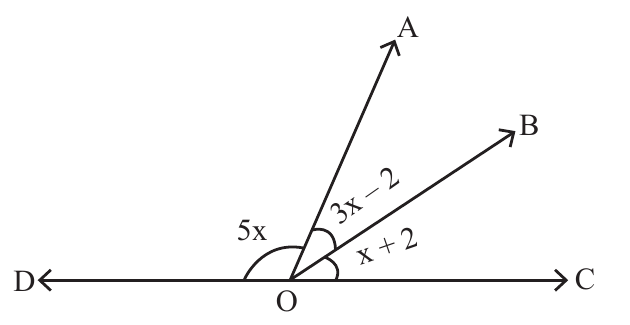
Q112 · Mathematics
In the given figure, the value of ∠AOD is
(Figure: D, O and C lie on a straight line; rays OA and OB rise from O. ∠AOD = 5x, ∠AOB = 3x − 2, ∠BOC = x + 2.)
(1)60°
(2)90°
(3)100°✓ Correct answer
(4)20°
Explanation
D, O and C lie on a straight line, so 5x + (3x − 2) + (x + 2) = 180°, giving 9x = 180° and x = 20°. Then ∠AOD = 5x = 100°; option (D), 20°, is only the value of x.
Q113 · Mathematics
Which fraction among 13/15, 15/17, 17/19 and 19/21 is the largest fraction ?
(1)19/21✓ Correct answer
(2)13/15
(3)17/19
(4)15/17
Explanation
Each fraction is 1 minus 2/denominator: 13/15 = 1 − 2/15, 15/17 = 1 − 2/17, 17/19 = 1 − 2/19 and 19/21 = 1 − 2/21. The smallest gap from 1 is 2/21, so 19/21 is the largest and 13/15 the smallest.
Q114 · Mathematics
For the curriculum development, which of the following should be considered as the center of education ?
(1)School
(2)Teacher
(3)Guardian
(4)Child✓ Correct answer
Explanation
Modern curriculum principles, and NCF 2005, put the child at the centre: the curriculum should follow the child's needs, interests, abilities and level of development. A teacher-centred (B) or school-centred (A) curriculum is the older approach.
Q115 · Mathematics
By which of the following tests, the learning difficulties and weaknesses of students in a particular subject can be detected ?
(1)Diagnostic test✓ Correct answer
(2)Achievement test
(3)Mental ability test
(4)Intelligence Quotient test
Explanation
A diagnostic test locates the specific learning difficulties and weak points of students in a subject, and is followed by remedial teaching. An achievement test (B) only measures how much has been learnt, without showing where or why the student goes wrong.
Q116 · Mathematics
The average of four consecutive even numbers is 23. The largest number among them is
(1)26✓ Correct answer
(2)24
(3)20
(4)18
Explanation
Four consecutive even numbers averaging 23 are spread evenly around 23: 20, 22, 24 and 26, whose sum is 92 = 4 × 23. The largest is 26; option (B), 24, is the second largest.
Q117 · Mathematics
Who among the following developed micro-teaching ?
(1)Burton
(2)Crow and Crow
(3)Dwight W. Allen✓ Correct answer
(4)Henry More
Explanation
Micro-teaching was developed by Dwight W. Allen and colleagues at Stanford University in 1963: a trainee teaches one skill in a short lesson to a small group and gets immediate feedback. In India it was spread by D. D. Tiwari (1967).
Q118 · Mathematics
If 3/10th part of a pole is in mud, 3/5th part is in water and the remaining 2 meters is above the water surface, then the length of a pole will be
(1)10 meters
(2)15 meters
(3)30 meters
(4)20 meters✓ Correct answer
Explanation
Mud and water together hold 3/10 + 3/5 = 3/10 + 6/10 = 9/10 of the pole, so the 2 m above water is 1/10 of it and the pole is 20 m long. Adding the fractions without a common denominator (6/15) leads to wrong answers.
Q119 · Mathematics
In mid-day meal, at the rate of 150 gm wheat and 100 gm rice per child per day, the total quantity of wheat and rice for 30 days for 60 children is
(1)450 kg✓ Correct answer
(2)180 kg
(3)270 kg
(4)400 kg
Explanation
Each child gets 150 g + 100 g = 250 g a day; for 60 children for 30 days that is 250 × 60 × 30 = 4,50,000 g = 450 kg. Option (C), 270 kg, is the wheat alone (150 × 60 × 30 g).
Q120 · Mathematics
The average of the cubes of the first five natural numbers is
(1)40
(2)64
(3)45✓ Correct answer
(4)50
Explanation
1³ + 2³ + 3³ + 4³ + 5³ = 1 + 8 + 27 + 64 + 125 = 225 (also (5 × 6 ÷ 2)² = 15²), and 225 ÷ 5 = 45. Option (B), 64, is only the cube of 4.
Q121 · Environmental Studies
Match the following and choose the correct answer.
(i) Viral disease — (a) Tuberculosis
(ii) Bacterial disease — (b) Malaria
(iii) Protozoan disease — (c) Kwashiorkor
(iv) Disease due to malnutrition — (d) Chicken pox
Chicken pox is caused by a virus (varicella-zoster), tuberculosis by a bacterium (Mycobacterium tuberculosis), malaria by a protozoan (Plasmodium), and kwashiorkor by protein deficiency. So the code is (i)-(d), (ii)-(a), (iii)-(b), (iv)-(c); option (A) wrongly pairs the viral disease with tuberculosis.
Q122 · Environmental Studies
‘Yak’ animal is found in which region of India ?
(1)Ladakh✓ Correct answer
(2)Darjeeling
(3)Arunachal Pradesh
(4)None of the above
Explanation
BSER's final key accepts both (A) and (C). The yak lives in cold, high Himalayan pastures, and India's yaks are found mainly in Ladakh, Arunachal Pradesh (Tawang and West Kameng), Sikkim and Himachal Pradesh. Darjeeling (B) has only a few yaks on its highest ridges and is not one of the main yak regions.
Q123 · Environmental Studies
Full form of ENVIS is
(1)Environmental Information System✓ Correct answer
(2)Environmental Impact Assessment
(3)Environment Protection Agency
(4)Environment Protection Council
Explanation
ENVIS is the Environmental Information System of the Union Ministry of Environment, started in 1982–83 as a network of centres that collect and share environmental data. Environmental Impact Assessment (B) is abbreviated EIA, a different tool used to assess projects.
Q124 · Environmental Studies
Who takes the first step on the moon after Neil Armstrong on 21 July, 1969 ?
(1)Yuri Gagarin
(2)Ellen Shepherd
(3)Kalpana Chawla
(4)Edwin Aldrin✓ Correct answer
Explanation
On the Apollo 11 mission (landing on 20 July 1969 US time, the first steps on 21 July UTC), Neil Armstrong stepped onto the Moon first and Edwin 'Buzz' Aldrin followed him. Yuri Gagarin (A) was the first human in space, in 1961, but never went to the Moon.
Q125 · Environmental Studies
Where is the Pandupol fair held ?
(1)Jaipur
(2)Ajmer
(3)Alwar✓ Correct answer
(4)Pander
Explanation
The Pandupol fair is held at the Pandupol Hanuman temple inside the Sariska Tiger Reserve in Alwar district, on Bhadrapada Shukla Ashtami; legend links the spot to the Pandavas. Jaipur (A) is the nearby big city, but the temple lies in Alwar district.
Q126 · Environmental Studies
Who named the ‘technology-ecosystem’ of third sub-complex to create artificial environment ?
(1)Odum
(2)Tansley
(3)Haeckel
(4)Haber✓ Correct answer
Explanation
BSER's final key gives Haber. Pedagogy books credit the German ecologist Wolfgang Haber with dividing the environment into sub-complexes (we could not confirm the exact wording in his own work): natural ecosystems, near-natural or agricultural ecosystems and, as the third, the technology-ecosystems (techno-ecosystems) that people build, such as cities and industries. Tansley (B) coined the word 'ecosystem' itself in 1935.
Q127 · Environmental Studies
In how many directions faces of lion are present in National Symbol of Ashok’s pillar ?
(1)One
(2)Two
(3)Three
(4)Four✓ Correct answer
Explanation
The Lion Capital of Ashoka at Sarnath has four lions standing back to back, facing the four directions; only three are visible in the State Emblem adopted on 26 January 1950. That is why 'three' (C) is the common wrong answer.
Q128 · Environmental Studies
In which season Patasan (Jute) is cultivated in India ?
(1)Winter
(2)Summer
(3)Rain✓ Correct answer
(4)Spring
Explanation
Jute is a kharif crop: it is sown around March–May and grows through the hot, humid rainy season, mainly in West Bengal, Bihar and Assam. It needs heavy rain and standing water for retting, so winter (A) is the wrong season.
Q129 · Environmental Studies
Deleted by BSER — marks given to all
How many decibel noise has been accepted to be the limit to tolerance in hospital areas according to International Standards ?
(1)65 dB
(2)90 dB
(3)105 dB
(4)140 dB
Explanation
BSER's final key dropped this question (marks to all) without giving a reason; a likely one is that none of the printed limits fits. Hospital areas fall in silence zones, where India's Noise Pollution (Regulation and Control) Rules 2000 set 50 dB in the day and 40 dB at night, and the WHO advises about 30 dB indoors in hospital ward rooms.
Q130 · Environmental Studies
Wild cock is the main wild animal of which Wildlife Sanctuary ?
(1)Sariska – Alwar
(2)Mount Abu – Sirohi✓ Correct answer
(3)Talchhapper – Churu
(4)Kailadevi – Karauli
Explanation
The Mount Abu Wildlife Sanctuary in Sirohi district is known for the grey jungle fowl (wild cock), which lives in its hill forests. Talchhapar in Churu (C) is famous instead for blackbuck, and Sariska (A) is a tiger reserve.
Q131 · Environmental Studies
Which is the largest planet of our solar system ?
(1)Uranus
(2)Neptune
(3)Jupiter✓ Correct answer
(4)Saturn
Explanation
Jupiter is the largest planet of the solar system; its mass is more than twice that of all the other planets put together. Saturn (D) is the second largest.
Q132 · Environmental Studies
Select the festival from the following, which is celebrated on new moon of the Kartika month.
(1)Holi
(2)Diwali✓ Correct answer
(3)Dussehra
(4)Raksha Bandhan
Explanation
Diwali, the festival of lights, falls on the new-moon night (amavasya) of Kartika. Holi (A) is on the full moon of Phalguna, Dussehra (C) on Ashwin Shukla Dashami and Raksha Bandhan (D) on the full moon of Shravana.
Q133 · Environmental Studies
Which teeth work to tear and chop the food ?
(1)Incisor
(2)Canine✓ Correct answer
(3)Molar
(4)Post molar
Explanation
Canines are the pointed teeth used to tear food; humans have four. Incisors (A) cut and bite, while the molars and post molars (C, D) chew and grind food.
Q134 · Environmental Studies
Following traffic sign indicates :
(1)Narrow bridge ahead
(2)Narrow road ahead✓ Correct answer
(3)Wider road ahead
(4)Dangerous deep ahead
Explanation
The triangular warning sign with two lines that bend inward and come closer means 'narrow road ahead'. The narrow bridge sign (A) shows straight parallel lines with short marks at the edges for the railings.
Q135 · Environmental Studies
Which of the following tools is the best use in ICT for visually impaired students ?
(1)Text to speech✓ Correct answer
(2)Projection Screen
(3)Social Networking
(4)Video conferencing
Explanation
Text-to-speech software reads digital text aloud, so visually impaired students can use e-books, websites and worksheets independently. A projection screen (B) depends entirely on sight, so it helps sighted learners, not these students.
Q136 · Environmental Studies
How will you be related to your mother’s brother’s mother ?
(1)Mami
(2)Nani✓ Correct answer
(3)Sister
(4)Mausi
Explanation
Your mother's brother is your mama, and his mother is your mother's mother, your nani. Mami (A) is the mama's wife.
Q137 · Environmental Studies
It is one of the deepest and largest stepwells in India
(1)Jhalaara of Turji
(2)Chand Stepwell of Abhaneri✓ Correct answer
(3)Big stepwell of Bhandaro
(4)Stepwell of Panna Meena
Explanation
The Chand Baori at Abhaneri in Dausa district, built in the 8th–9th century by King Chanda of the Nikumbha dynasty, is about 30 m deep with 13 storeys and about 3,500 steps, among the deepest and largest stepwells in India. Panna Meena ka Kund (D) near Amer is a smaller stepwell.
Q138 · Environmental Studies
Which objective is not about organising co-curricular activities ?
(1)Maintaining both physical and mental health
(2)To gain knowledge of virtues to be developed in children
(3)Introductory information of required equipment and tools
(4)To criterion educational program and teaching methods✓ Correct answer
Explanation
Co-curricular activities aim at physical and mental health, building virtues such as cooperation and leadership, and practical familiarity with equipment and tools. Testing (putting to the test) the educational programme and teaching methods is a purpose of evaluation, not of organising co-curricular activities.
Q139 · Environmental Studies
Which is not a traditional method of diverting water to fields from wells, lakes and canals ?
(1)Pulley
(2)Dhekli
(3)Rahat
(4)Drip system✓ Correct answer
Explanation
Mot (a pulley-and-bucket lift), dhekli (a lever lift) and rahat (the Persian wheel) are traditional ways of lifting water to fields. Drip irrigation is a modern method that delivers water drop by drop to plant roots through pipes and saves water.
Q140 · Environmental Studies
Which of the following material is most important to be carried by a mountaineer ?
(1)Sleeping bag
(2)Oxygen kit✓ Correct answer
(3)Blanket
(4)Torch
Explanation
At high altitude the air is thin and carries less oxygen, so climbers on very high peaks carry oxygen cylinders to avoid altitude sickness. A sleeping bag (A) is also needed, but without oxygen a climber's life is at risk.
Q141 · Environmental Studies
Which activity is punishable under Section 112 – 183 of the ‘Motor Vehicle Act’ ?
(1)An accident or fast driving✓ Correct answer
(2)Things of an unsafe manner
(3)Using horn in peace (no horn) zone
(4)Driving without a license
Explanation
BSER's final key accepts both (A) and (D). Section 112 of the Motor Vehicles Act 1988 sets speed limits and Section 183 lays down the penalty for driving too fast, so fast driving (A) fits; the key also accepts driving without a licence (D). Using a horn in a silence zone (C) is punished under Section 194F.
Q142 · Environmental Studies
When did Bachendri Pal set foot on the peak of Mount Everest ?
(1)23 May, 1984✓ Correct answer
(2)25 May, 1984
(3)23 May, 1989
(4)25 May, 1989
Explanation
Bachendri Pal became the first Indian woman to climb Mount Everest on 23 May 1984, as part of the Everest '84 expedition. Junko Tabei of Japan had been the first woman on the summit, in 1975.
Q143 · Environmental Studies
Which alkaloid is not found in the opium ?
(1)Morphine
(2)Codeine
(3)Sominiferine
(4)Caffeine✓ Correct answer
Explanation
Opium, the dried latex of the poppy (Papaver somniferum), contains alkaloids such as morphine, codeine, thebaine and papaverine. Caffeine is the alkaloid of coffee and tea, not of opium.
Q144 · Environmental Studies
Which teaching material is used to correct the language related errors in students ?
(1)Museum
(2)Map
(3)Phonograph✓ Correct answer
(4)Line diagram
Explanation
A phonograph is an audio aid that plays recorded speech, so pupils can listen to correct pronunciation and compare their own speech, which helps correct language errors. A museum, map or line diagram (A, B, D) are visual aids that do not model spoken language.
Q145 · Environmental Studies
Which is the State flower of Rajasthan ?
(1)Lotus
(2)Palash
(3)Rohida✓ Correct answer
(4)Amaltash
Explanation
Rohida (Tecomella undulata), known as the 'marwar teak', was declared the state flower of Rajasthan in 1983. The lotus (A) is the national flower of India.
Q146 · Environmental Studies
Deleted by BSER — marks given to all
Which fort of Rajasthan is also known as Ajaygarh ?
(1)Sonar fort
(2)Kumbhalgarh fort
(3)Mehrangarh fort
(4)Ranthambore fort
Explanation
BSER's final key dropped this question (marks to all) without giving a reason. Kumbhalgarh is often called Ajaygarh (the unconquerable fort) because it was never taken by direct assault; Ajaygarh is also the name of a separate fort in Panna district, Madhya Pradesh.
Q147 · Environmental Studies
Disease caused by the deficiency of Vitamin – D is
(1)Night blindness
(2)Beri-Beri
(3)Scurvy
(4)Rickets✓ Correct answer
Explanation
Lack of vitamin D (made in the skin in sunlight) causes rickets in children, with soft, bent bones. Night blindness (A) comes from vitamin A deficiency, beri-beri (B) from vitamin B1 and scurvy (C) from vitamin C.
Q148 · Environmental Studies
Which of the following is a component of man made environment ?
(1)Lithosphere
(2)Industry✓ Correct answer
(3)Community
(4)Hydrosphere
Explanation
The man-made (cultural) environment includes things humans have built, such as industries, buildings, roads and dams. The lithosphere and hydrosphere (A, D) are parts of the natural environment, and a community (C) belongs to the social environment.
Q149 · Environmental Studies
Which of the following is a good breed of goat ?
(1)Murrah
(2)Gir
(3)Sahiwal
(4)Jamunapari✓ Correct answer
Explanation
Jamunapari is a large goat breed from the Etawah region, valued for milk and meat. Murrah (A) is a buffalo breed, and Gir and Sahiwal (B, C) are cattle breeds.
Q150 · Environmental Studies
Which chemist’s philosophy became famous by the name of ‘Nihilism’ ?
(1)Neils Bore
(2)Dmitri Mendeleev
(3)Acharya Prafull Chand Ray
(4)Nagarjuna✓ Correct answer
Explanation
BSER's final key gives Nagarjuna (D). The Buddhist philosopher Nagarjuna taught Shunyavada (Madhyamaka), which the paper renders as 'Nihilism', and Indian tradition credits a Nagarjuna, possibly a later namesake, with alchemy (rasashastra), which is why the paper calls him a chemist. Acharya Prafulla Chandra Ray (C) was a modern chemist who wrote 'A History of Hindu Chemistry'.
Questions: Board of Secondary Education, Rajasthan (Ajmer). Answers: BSER final answer key. Explanations: TopKaro.